
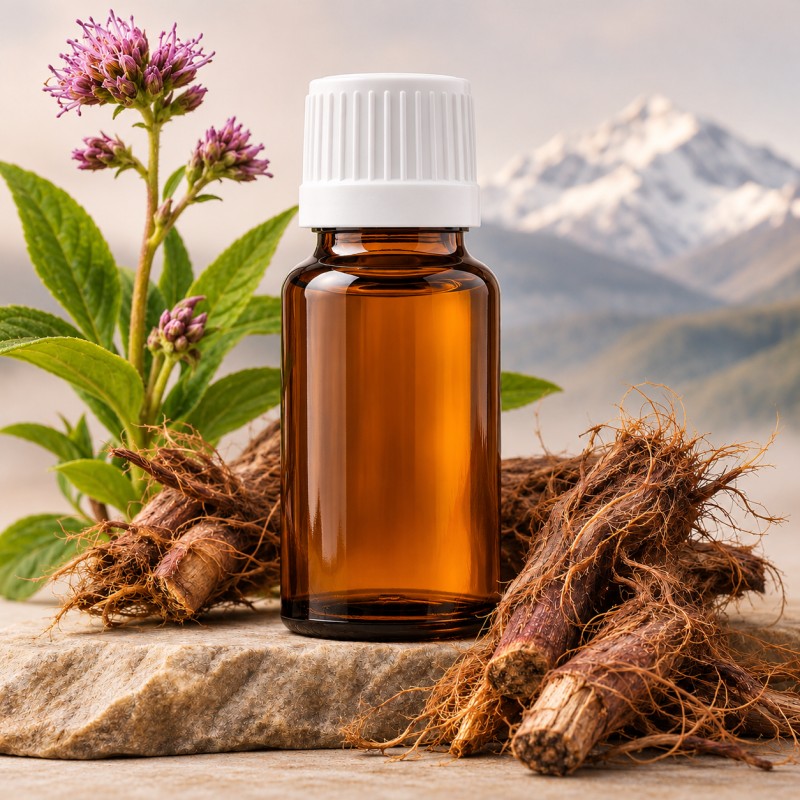


Jatamansi Essential Oil
Discover the unique world of scents offered by Jatamansi Essential Oil, also known as Spikenard Essential Oil or Nardus Oil. This distinctive essential oil is known for its deep, earthy, and woody aroma, with warm, spicy, musky, and subtly smoky notes. Jatamansi has a complex and distinctive scent that is highly prized in natural perfumery.
The essential oil is extracted from the aromatic roots and rhizomes of Nardostachys jatamansi, also known by its botanical name, Nardostachys grandiflora. This unique plant grows in the mountainous regions of the Himalayas and has been known for centuries for its fragrant underground parts.
The volatile aromatic compounds are extracted from the plant material through steam distillation. The result is a concentrated essential oil with a powerful, warm, and rich fragrance profile.
Jatamansi has a distinct natural scent reminiscent of damp forest soil, aromatic roots, dark wood, mild spices, and a hint of musk. Due to its deep and long-lasting character, the oil is primarily used to add extra warmth, complexity, and depth to perfumes, incense-like fragrance compositions, and other scent creations.
What Does Jatamansi Essential Oil Smell Like?
Jatamansi has an intense, distinctive, and versatile scent profile that develops gradually. Upon first inhalation, the earthy, herbal, and slightly root-like notes are particularly noticeable. Then, the warm woody, musky, and subtly smoky nuances come to the fore.
The scent is often compared to vetiver and patchouli, but it has a character all its own. Whereas vetiver is often drier and smokier and patchouli has a recognizable, dark, earthy scent, Jatamansi combines these qualities with a softer, warm, and slightly animalic musky undertone.
The scent profile of Jatamansi:
- Earthy: deep, natural scent notes reminiscent of damp earth, roots, and forest soil.
- Woody: warm, dark woody notes that lend the fragrance profile a rich and elegant character.
- Musk: soft, warm, and slightly animalic nuances that add extra depth.
- Spicy: subtle, aromatic, spice-like accents that add complexity to the scent.
- Smoky: light, incense-like nuances that contribute to a mysterious aura.
- Balsamic: warm, rounded undertones that tie the various fragrance notes together.
In perfumery, Jatamansi is primarily considered a base note. Base notes form the foundation of a perfume and generally linger longer than fresh top notes. This makes Jatamansi particularly interesting for perfumes that call for depth, warmth, and a long-lasting, earthy scent profile.
The Origin of Jatamansi – Nardostachys jatamansi
Jatamansi comes from a unique aromatic plant native to the Himalayas. The plant grows naturally in mountainous regions of Nepal, India, and Bhutan, among other places, where it is found at high altitudes.
The plant belongs to the honeysuckle family (Caprifoliaceae) and is also classified in older botanical literature as part of the valerian family (Valerianaceae). Jatamansi develops aromatic rhizomes and roots that are responsible for its characteristic scent.
The name Jatamansi originates from South Asia, where the plant has long been valued as an aromatic raw material. The oil is also known internationally as Spikenard, Indian Nard, and Nard Oil.
Jatamansi has a long history in traditional fragrance cultures. Its aromatic roots were used in incense blends, fragrant oils, and other traditional preparations. Spikenard also holds a special place in the history of perfumery because of its deep, warm, and earthy aroma.
To produce Jatamansi essential oil, the aromatic roots and rhizomes are processed and are typically dried before being distilled. During steam distillation, the volatile aromatic compounds are released from the plant material and collected.
The final oil has a rich, complex aroma profile. The exact composition and intensity of the aroma may vary depending on the plant’s origin, harvesting conditions, and the distillation process.
What Can You Use Jatamansi Essential Oil For?
Thanks to its intense and versatile scent, Jatamansi is an interesting raw material for both experienced perfumers and creative enthusiasts of natural fragrances. The oil really shines in fragrance compositions that emphasize warmth, depth, and a distinctive character.
1. Perfume Making and Natural Perfumery
Jatamansi is a valuable fragrance component in natural perfumery. The oil is used in woody, earthy, musky, amber-like, and oriental fragrance compositions.
Jatamansi can provide a rich, warm, and long-lasting base, especially in perfumes with a distinctly natural character. Thanks to its deep fragrance profile, the oil can help bind other fragrance components together and add complexity to a perfume.
Jatamansi can also play an interesting role in niche perfumes that feature unique botanical fragrances. The oil blends well with fresh citrus notes, floral ingredients, and deep woody base notes.
Jatamansi pairs well with, among others:
- Woody and Earthy Fragrances
- Amber-like and oriental fragrance compositions
- Musk-like and warm unisex scents
- Incense-like and resinous fragrances
- Natural niche fragrances
- Chypre-like fragrance compositions
- Dark, spicy, and mysterious fragrance accords
For example, combine jatamansi with sandalwood, patchouli, and bergamot for an elegant woody scent. For a deeper, more mysterious composition, try experimenting with frankincense, vetiver, and myrrh.
2. Diffusers and Home Fragrances
The warm, earthy, and woody scent of Jatamansi makes this essential oil ideal for diffuser blends and luxurious home fragrances. The oil can lend a fragrance composition a deep, natural, and atmospheric quality.
Jatamansi, for example, is well-suited for creating fragrance profiles that evoke a serene forest setting, a warm, wood-paneled room, or an interior featuring natural materials and subtle notes of incense.
For a lighter scent, you can combine jatamansi with bergamot, orange, or lavender. For a warmer and more intense scent experience, sandalwood, cedarwood, and frankincense pair particularly well.
Due to its powerful aroma, it’s wise to start with small amounts and gradually build up the fragrance composition.
Use the oil exclusively in suitable diffusers and follow the manufacturer’s instructions. Always check the safety of the entire fragrance blend.
3. Scented Candles and Wax Melts
Jatamansi can be used as part of a fragrance blend for scented candles and wax melts. Its deep, woody, and earthy notes pair perfectly with warm, spicy, and resinous fragrance themes.
For example, combine Jatamansi with cedarwood and vanilla for a warm, inviting scent. Pairing it with patchouli and frankincense creates an intense, mysterious blend, while bergamot and sandalwood result in a more elegant and balanced fragrance.
The performance of essential oils in candles depends on factors such as the type of wax, the fragrance concentration, the wick, and the chosen processing temperature.
Therefore, always test the scent diffusion, compatibility, and burn performance of the complete formula before finalizing the development of a scented candle or wax melt.
4. Homemade Cosmetics and Personal Care Products
Jatamansi Essential Oil can be used as a fragrance component in suitable cosmetic formulations, such as perfumes, body oils, balms, and other scented personal care products.
Its warm, musky, and woody scent makes the oil an attractive choice for luxury cosmetic products that emphasize a natural and refined fragrance profile.
In cosmetic fragrance compositions, Jatamansi can be combined with soft floral ingredients, fresh citrus notes, or other woody essential oils.
Please note: Essential oils are highly concentrated and should not be used undiluted on the skin. The safe concentration for use depends on the oil’s composition, the type of end product, and the comprehensive safety assessment.
For cosmetic products placed on the market, the entire formulation must comply with applicable cosmetics regulations.
5. Incense and Aromatic Fragrance Creations
Jatamansi has a long history as an aromatic raw material for incense-like fragrance compositions. Its deep, earthy, and musky scent blends particularly well with resins, woods, and warm spices.
The oil can be used to create fragrance notes reminiscent of traditional incense, dark woods, and exotic resins.
For example, combine Jatamansi with frankincense, myrrh, and sandalwood for a rich, warm, and balsamic fragrance composition.
For applications in which fragrances are heated or burned, the safety, suitability, and performance of the entire formulation must be evaluated separately.
Which Essential Oils Does Jatamansi Blend Well With?
Jatamansi is a versatile base note that pairs exceptionally well with various fragrance families. Its earthy and musky nuances blend beautifully with both fresh and warm ingredients.
- Sandalwood: adds soft, creamy woody notes that round out the intense character of Jatamansi.
- Patchouli: enhances the deep, earthy, and warm nuances for a rich, characterful fragrance.
- Vetiver: combines musky warmth with dry, smoky, and woody accents.
- Frankincense: adds a resinous, balsamic, and slightly mysterious character.
- Myrrh: enhances the warm, dark, and resinous nuances.
- Cedarwood: creates a dry, woody base that complements the earthy scent of Jatamansi.
- Bergamot: provides a fresh citrus opening that beautifully balances the dark base notes.
- Lavender: brings a soft, aromatic, and floral contrast to the composition.
- Orange: adds a fresh, slightly sweet citrus note that softens the warm fragrance profile.
- Ylang-ylang: creates a rich, exotic floral accent that contrasts beautifully with the earthy base.
Fragrance Inspiration: Create Your Own Jatamansi Blend
Want to experiment with Jatamansi Essential Oil? The scent ideas below show you how to combine the deep, earthy, and woody qualities of this oil with different scent profiles.
Himalayan Woods – Deep and Woody
Combine Jatamansi with sandalwood, cedarwood, and vetiver. This fragrance composition brings together warm woody notes, earthy nuances, and subtle smoky accents. A beautiful inspiration for natural perfumes and luxurious home fragrances.
Mystic Amber – Warm and Mysterious
Combine Jatamansi with patchouli, frankincense, and a warm, amber-like fragrance component. The result is a deep and characterful scent centered around earthy, musky, and balsamic nuances.
Botanical Elegance – Fresh and Refined
Combine Jatamansi with bergamot, lavender, and sandalwood. The fresh, aromatic top notes are complemented by soft woody notes, while Jatamansi provides a warm, natural base.
Ancient Incense – Rich and Balsamic
Combine Jatamansi with frankincense, myrrh, and cedarwood. This fragrance composition evokes aromatic resins, dark wood, and traditional incense. A unique inspiration for lovers of deep, warm fragrance profiles.
These fragrance combinations are intended as creative inspiration and not as ready-to-use, safety-tested recipes. The correct ratios, compatibility, and safe usage concentrations must be determined individually for each application.
Why Use Jatamansi Essential Oil?
What makes Jatamansi special is the combination of a deep, earthy scent, warm woody nuances, and a soft, musky undertone. The oil has a distinctive character that sets it apart from many other essential oils.
While fresh citrus oils primarily provide a lively opening and floral oils add elegance, Jatamansi brings warmth, depth, and a long-lasting scent profile to a composition.
This makes the oil particularly appealing to perfumers who enjoy working with natural base notes and distinctive botanical ingredients.
Here’s a summary of its key properties:
- A deep, earthy, and woody fragrance profile
- Warm, musky, and spicy nuances
- Subtle smoky and balsamic accents
- A valuable base note for perfume compositions
- Of interest for natural perfumery and fragrance development
- Blends well with woods, citrus, resins, and spices
- A unique aromatic raw material from the Himalayan region
Product Information: Jatamansi Essential Oil
- Product Name: Jatamansi Essential Oil
- English name: Jatamansi Essential Oil
- Other Names: Spikenard Oil, Nard Oil, Indian Spikenard
- Botanical name: Nardostachys jatamansi
- Botanical synonym: Nardostachys grandiflora
- Plant family: Caprifoliaceae (formerly Valerianaceae)
- Plant part: Roots and rhizomes
- Common extraction method: Steam distillation
- Fragrance profile: Earthy, woody, musky, and spicy
- Fragrance note: Base note
- Typical color: Yellow to amber or brownish
- Common INCI Name: Nardostachys Jatamansi Rhizome/Root Extract
The exact odor, color, composition, and other product specifications may vary depending on the origin and production batch. Please refer to the current product documentation for the specific properties of the oil supplied.
Storage and Safe Use
Jatamansi Essential Oil is a highly concentrated aromatic raw material. Careful use and proper storage are important for maintaining quality and ensuring safe use.
- Do not apply the essential oil undiluted to the skin.
- Avoid contact with the eyes and mucous membranes.
- Not intended for internal use.
- Keep out of reach of children and pets.
- Store the oil tightly sealed in a cool, dry, and dark place.
- Check the current safety information and any restrictions on use before use.
- Use the oil in cosmetic products only at concentrations deemed safe.
- Prevent the release of concentrated oil into the environment.
Buy Jatamansi Essential Oil at YouWish
Are you looking for a unique essential oil for your next perfume, diffuser blend, or other fragrance creation? With Jatamansi Essential Oil, you can add a deep, earthy, and woody character to your fragrance compositions.
The combination of warm, musky notes, subtle spiciness, and a rich woody base makes Jatamansi an interesting choice for lovers of natural perfumery and exclusive fragrances.
Whether you’re experimenting with a woody unisex fragrance, a unique incense-like composition, or an atmospheric home fragrance: Jatamansi offers plenty of possibilities for developing unique and distinctive scents.
Discover the mysterious aroma of Jatamansi and give your fragrance creations a deep, warm, and distinctive character.


Reviews
There are no reviews yet.