
Reach for a bottle of lemon oil that has been sitting open for a year, and you might find that bright, zesty aroma has vanished, replaced by something resembling stale floor cleaner. That is oxidation at work, and it sets in far quicker than most people expect. For anyone formulating soap, candles, or skincare, this is especially frustrating: an oxidized oil won’t just smell off—it can ruin an entire batch.
Below, we cover how to store your essential oils properly, typical shelf lives across different botanical families, and the telltale signs that a bottle is past its prime.
At a glance:
- Keep essential oils sealed tightly in amber glass bottles and stored in a cool, dark place.
- Choose smaller bottles over half-empty large ones; excess headspace accelerates oxidation.
- Citrus oils are the most fragile, while resinous and woody oils like patchouli and sandalwood last for years.
- Always mark the opening date on the label, and never apply oxidized oils to the skin.
What Happens Inside the Bottle
Essential oils are composed of volatile organic compounds that naturally break down when exposed to oxygen. Heat, light, and humidity dramatically accelerate this decay. According to the Tisserand Institute, oxidation is the single biggest cause of essential oil degradation.
The institute highlights a study that clearly demonstrates how drastically storage conditions affect oil quality: lemon oil stored at 25°C and opened for three minutes daily lost over two-thirds of its limonene content within twelve months, dropping from 68.5% to 20.1%. When stored at 5°C and opened only once a month, however, the oil showed virtually no measurable loss.
This degradation goes beyond a faded scent. As limonene and linalool oxidize, they form hydroperoxides—potent contact allergens capable of triggering severe skin reactions and sensitisation. Formulating a lotion or soap with degraded oil is not merely a cosmetic mistake; it introduces genuine dermatological risks.
How Long Do Essential Oils Last?
An oil’s chemical makeup directly determines its stability. Citrus oils are packed with light monoterpenes like limonene, leaving them highly vulnerable to oxidation. In contrast, heavier molecules found in woods, roots, and resins offer much greater stability over time.
Here is a general guide to expected shelf lives for opened bottles kept under proper storage conditions. Because estimates vary slightly across industry sources, treat these as reliable ranges rather than strict expiry dates:
| Oil Type | Examples | Shelf Life After Opening (Approx.) |
|---|---|---|
| Citrus | lemon, bergamot, orange, grapefruit | 6 to 12 months |
| Conifer / needle oils | pine, spruce, cypress | 1 to 3 years |
| Herbs and florals | lavender, rosemary, geranium | 2 to 4 years |
| Wood and resin | sandalwood, patchouli, vetiver | 4+ years |
Unopened bottles kept in ideal conditions typically last one to two years longer. In fact, oils like patchouli, vetiver, and sandalwood are renowned for maturing gracefully, developing deeper, richer aromatic profiles as they age.
Pay close attention to tea tree oil. Despite its reputation as a resilient antimicrobial, it oxidizes remarkably fast. A study conducted by the German Federal Institute for Risk Assessment (BfR) found that the peroxide levels in tea tree oil jumped from 25 to roughly 500 ppm in as little as six weeks once exposed to air. Buy tea tree oil in modest amounts, and aim to work through the bottle quickly.
Everyday Best Practices for Essential Oil Storage
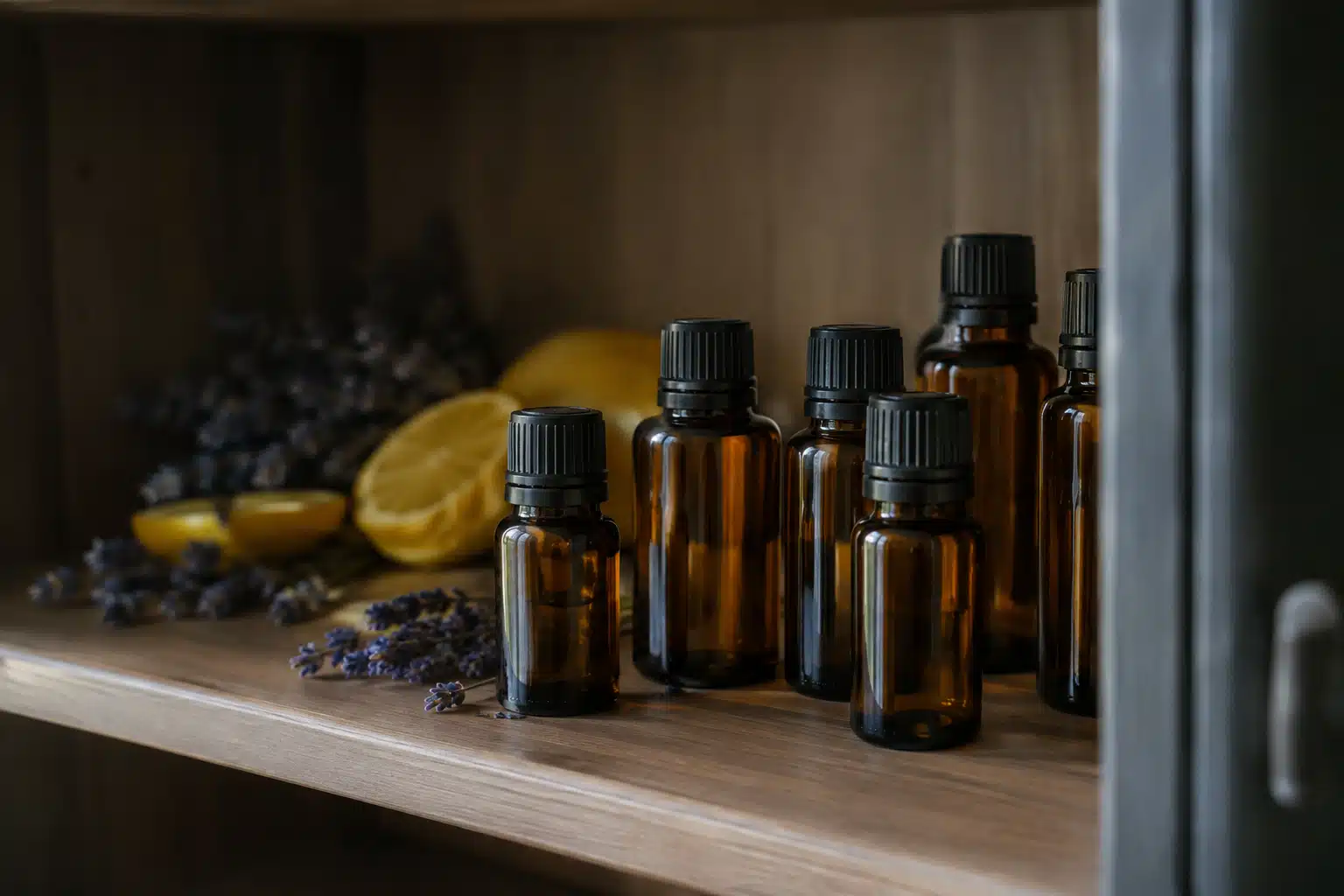
Stick to dark glass. Amber glass blocks out roughly 90% of damaging UV light. Cobalt blue glass is a workable alternative if your bottles live in an enclosed cupboard, but clear glass should always be avoided. Never store pure essential oils in plastic long-term; concentrated terpenes will soften, warp, or dissolve plastic over time. If an oil arrives in a plastic container, decant it into glass straight away.
Eliminate headspace. Each time you uncap an oil to dispense a few drops, fresh oxygen enters the bottle. A 100 ml bottle that is half-empty holds 50 ml of trapped air right above the oil surface. Decanting your remaining oil into a clean 50 ml bottle removes that surplus oxygen. Fill the smaller bottle close to the shoulder to keep air exposure to a minimum.
-
 €0.25 €29.95Price range: €0.30€0.25 through €29.95€29.95 incl. VAT inc. VATExcl. VATSelect options This product has multiple variants. The options may be chosen on the product page
-
€0.29 €21.49Price range: €0.35€0.29 through €26.00€21.49 incl. VAT inc. VATExcl. VATSelect options This product has multiple variants. The options may be chosen on the product page
-
€0.31 €21.49Price range: €0.37€0.31 through €26.00€21.49 incl. VAT inc. VATExcl. VATSelect options This product has multiple variants. The options may be chosen on the product page

Choose the right closures. Dropper caps fitted with rubber bulbs should never be used for ongoing storage. Essential oil vapors attack natural rubber, turning it gummy, swollen, and prone to degrading into the oil itself. Stick to standard screw caps fitted with an oil-resistant orifice reducer (euro dropper) or use a separate glass pipette when dispensing. After pouring, wipe the bottle neck clean with a dry cloth—lingering oil on the threads will oxidize, turn sticky, and seal the cap shut.
Pick a stable, cool environment. A cupboard in a cool room kept consistently between 5°C and 20°C is ideal. Keep bottles away from window ledges, spots directly above radiators, and hot vehicle interiors. Bathrooms are notoriously poor storage locations due to constant steam and temperature swings.
Refrigeration: Great for Citrus, but Not a Magic Bullet
The Tisserand Institute suggests that refrigeration can roughly double the usable life of delicate essential oils. However, cold storage is not universally beneficial. A 2006 study by Wabner, Geier, and Hauck revealed higher peroxide values in certain refrigerated oils compared to samples stored at room temperature, suggesting that chilling is not a one-size-fits-all solution.
In practical terms, the fridge is best reserved for delicate citrus oils and large bulk bottles you don’t dip into regularly. Store bottles toward the back of the fridge rather than in the door racks, and verify that caps are screwed down tight so the oils don’t absorb food aromas. Always let chilled bottles come up to room temperature before opening them; cracking them open cold causes ambient moisture to condense inside the bottle, hastening spoilage.
How to Tell if an Essential Oil Has Expired
Rely on your senses. An oxidized essential oil will lose its characteristic vibrancy, often taking on a harsh, sour, or chemical odor. Visually, watch out for thickening, a gummy texture, or cloudiness (a clear sign of water ingress). If you notice any of these changes, retire the bottle from topical use immediately.
The simplest way to avoid second-guessing is to jot down the month and year you broke the seal directly on the bottle. If you make your own cosmetics, dating your oils also makes batch tracking much simpler.
Safe Storage at Home
Always store essential oils well out of reach of children and household pets. As highlighted by the Dutch consumer safety resource Waarzitwatin, these botanicals are concentrated, flammable compounds that should never be consumed. Flash points vary significantly across oils: standard safety data sheets show a flash point of 40°C for pine, 45°C for geranium, and 68°C for lavender. Keep your collection well clear of open flames, lit candles, and hot cooktops.
If you are crafting candles, take a look at our guide to essential oils in candles and brush up on key essential oil safety guidelines. Interested in blending bespoke scents? Our beginner’s guide on making perfume with essential oils covers the basics of formulation. Handcrafted soaps demand their own storage considerations, which you can explore in how to store soap and its shelf life.
Keeping oils fresh comes down to four basics: dark, cool, airtight, and correctly sized. Take a quick inventory of your stash, mark opening dates on unlabeled bottles, and shift your citrus oils somewhere cool. Looking to restock? Browse our collection of pure essential oils.


