
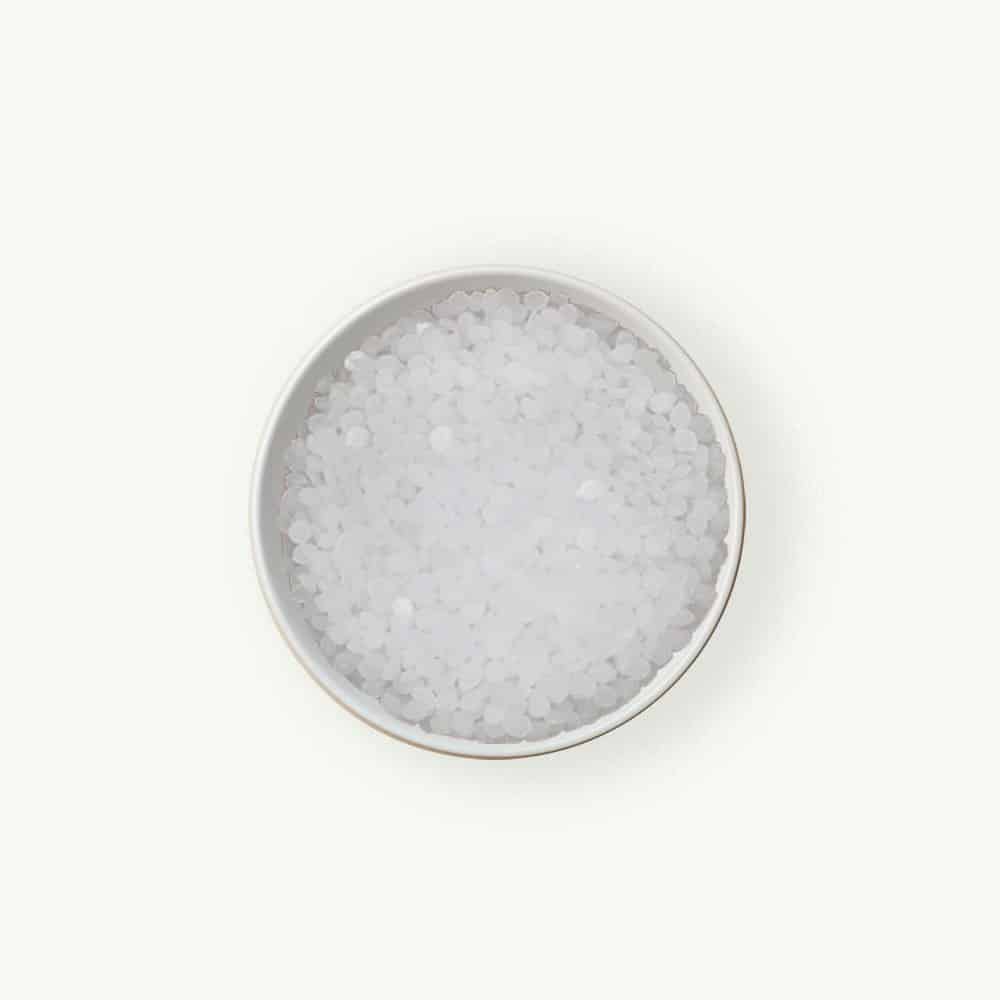


PEG-100 Stearate
PEG-100 Stearate is a commonly used cosmetic emulsifier that helps combine water and oil into a stable emulsion. This ingredient is primarily used in creams, lotions, cleansers, conditioners, and other personal care products that require the blending of an aqueous phase and an oil phase.
In practice, PEG-100 Stearate is often combined with Glyceryl Stearate. This combination forms a versatile emulsifying system that can be used to create a wide range of oil-in-water emulsions, from light body lotions to rich face and hand creams.
PEG-100 Stearate does more than just help form an emulsion. It can also contribute to the stability, spreadability, creaminess, and skin feel of the final product. The final properties depend on the concentration used, the oil-to-water ratio, the thickeners present, and the entire production process.
INCI: PEG-100 Stearate
What is PEG-100 Stearate?
PEG-100 Stearate is a nonionic surfactant produced by combining stearic acid with a polyethylene glycol chain. The number 100 refers to the average degree of ethoxylation and, consequently, to the average length of the polyethylene glycol portion of the molecule.
The molecule contains both a fat-loving and a water-loving part:
- The stearate portion has an affinity for oils and fats.
- The PEG portion has an affinity for water.
Because of this dual affinity, PEG-100 Stearate can position itself between the oil and water phases. It reduces the interfacial tension and helps distribute small oil droplets evenly throughout the water phase.
PEG-100 Stearate is typically used to make oil-in-water emulsions. In this type of emulsion, water forms the outer phase, and small droplets of oil are dispersed throughout the water. This type of emulsion is widely used in cosmetic creams and lotions because it generally feels less greasy than a water-in-oil emulsion.
What is PEG-100 Stearate used for?
The primary function of PEG-100 Stearate is to emulsify water and oil. Depending on the formulation, this ingredient can also contribute to various other product properties.
1. Formation of oil-in-water emulsions
Water and oil do not naturally mix permanently. When these phases are mixed without an emulsifier, they will separate again over time.
PEG-100 Stearate helps counteract this process. During emulsification, tiny oil droplets are dispersed throughout the aqueous phase. The emulsifier molecules surround these droplets and help prevent them from coalescing again too quickly.
2. Stabilizing creams and lotions
PEG-100 Stearate helps maintain the stability of emulsions. A well-formulated emulsification system can help prevent:
- Oil collects at the top of the product
- Water separates from the cream
- The emulsion becomes thinner during storage
- The cream takes on an uneven texture
- The formula breaks down when the temperature changes
However, the presence of PEG-100 Stearate alone does not guarantee a stable emulsion. The oil content, the chosen co-emulsifiers, thickeners, processing temperature, mixing speed, and cooling method are also important.
3. Improving spreadability
PEG-100 Stearate can help ensure that a cosmetic product spreads smoothly and evenly over the skin. A well-balanced emulsion spreads easily and does not immediately feel heavy or sticky.
The final sensation on the skin is partly determined by:
- The amount of PEG-100 Stearate
- The type of oil
- The percentage of the oil phase
- The fatty alcohols used
- The presence of butters and waxes
- The moisturizing ingredients used
4. Improving the product structure
PEG-100 Stearate, when combined with ingredients such as Glyceryl Stearate, Cetearyl Alcohol, Cetyl Alcohol, and Stearic Acid, can create a creamy and stable product texture.
The ingredient alone is not always sufficient to make a thick or rich cream. Additional thickening agents are often used to increase viscosity.
Examples include:
- Cetearyl Alcohol
- Cetyl Alcohol
- Stearyl Alcohol
- Stearic Acid
- Cetyl Palmitate
- Xanthan Gum
- Carbomer
- Hydroxyethylcellulose
5. Helps keep skin feeling soft
PEG-100 Stearate is often combined with emollients and fatty ingredients that make the skin feel soft and smooth. The emulsifier helps distribute these ingredients evenly throughout the formula.
PEG-100 Stearate is not primarily an active skincare ingredient like glycerin, panthenol, or hyaluronic acid. Its main role is in the technical formulation and stability of the product.
PEG-100 Stearate and Glyceryl Stearate
PEG-100 Stearate is very commonly used in combination with Glyceryl Stearate. This combination is sold by various suppliers as a ready-to-use emulsifying wax or self-emulsifying base.
The INCI is then usually listed as:
Glyceryl Stearate, PEG-100 Stearate
The two ingredients serve somewhat different functions:
- PEG-100 Stearate functions primarily as a hydrophilic oil-in-water emulsifier.
- Glyceryl Stearate acts as a co-emulsifier, emollient, and texture enhancer.
Together, they can form a robust emulsification system suitable for a wide variety of cosmetic products.
It is important to distinguish between pure PEG-100 stearate and a commercial blend of glyceryl stearate and PEG-100 stearate. The recommended dosage and processing methods may differ.
The Difference Between PEG-100 Stearate and Glyceryl Stearate
PEG-100 Stearate and Glyceryl Stearate are not the same ingredient.
PEG-100 Stearate has relatively strong hydrophilic properties and is primarily used as an oil-in-water emulsifier.
Glyceryl Stearate is an ester of glycerin and stearic acid. It can contribute to the structure, emollient properties, and stability of a formulation, but in many cases it is not potent enough on its own to form a stable oil-in-water emulsion.
An ingredient that contains only glyceryl stearate may therefore function differently than a self-emulsifying mixture of glyceryl stearate and PEG-100 stearate.
The Difference Between Glyceryl Stearate and Glyceryl Stearate SE
Glyceryl Stearate SE is also not the same as regular Glyceryl Stearate. The letters “SE” stand for ” self-emulsifying.”
In addition to glyceryl stearate, glyceryl stearate SE usually contains an additional soap-like emulsifier, such as sodium stearate or potassium stearate. As a result, it can help form an emulsion on its own.
A combination of glyceryl stearate and PEG-100 stearate uses a different emulsification mechanism and may therefore have a different feel on the skin, different pH sensitivity, and different formulation properties.
These raw materials should not be replaced on a one-to-one basis without reformulation.
In which products can PEG-100 Stearate be used?
PEG-100 Stearate has a wide range of applications in cosmetic and personal care products that require the combination of oil and water.
Facial Care
- Day Creams
- Night Creams
- Moisturizing Face Creams
- Anti-aging creams
- Eye creams
- Facial Lotions
- Cleansing Creams
- Cleansing Milk
Body care
- Bodylotions
- Body Lotions
- Hand Creams
- Foot creams
- After-sun products
- Massage Creams
- Baby Care Products
Haircare
- Conditioners
- Hair masks
- Leave-in creams
- Styling Creams
- Creams for Curly Hair
- Scalp Care
Cleaning products
- Creamy facial cleansers
- Cleansing Milk
- Makeup Removers
- Creamy body wash
- Mild cleansing emulsions
Other Cosmetic Applications
- Sunscreen Lotions
- Aftershave balms
- Deodorant creams
- Moisturizing emulsions
- Cosmetic treatment creams
How do you use PEG-100 Stearate?
PEG-100 Stearate is typically incorporated into the heated oil phase of an emulsion. Because the material is usually solid and waxy, it must be completely melted before the water and oil phases are combined.
General Procedure
- Weigh all the ingredients accurately.
- Add PEG-100 Stearate to the oil phase.
- Add any fatty alcohols, waxes, butters, and oils.
- Heat the oil phase until all the solid ingredients have completely melted.
- Heat the aqueous phase separately to approximately the same temperature.
- Combine the aqueous and oil phases according to the chosen production process.
- Mix or homogenize until a uniform emulsion forms.
- Keep stirring regularly while it cools.
- Add heat-sensitive ingredients during the cooling phase.
- Check the pH of the final product.
- Fill the emulsion to the appropriate temperature.
The exact processing temperature depends on the product grade used and the other ingredients. In hot emulsion processes, the phases are often combined at around 70 to 75 degrees Celsius, but the supplier’s technical specifications always take precedence.
Recommended Dosage of PEG-100 Stearate
The correct dosage depends on whether pure PEG-100 Stearate is used or a mixture containing, for example, Glyceryl Stearate.
As a general guideline for formulation, PEG-100 Stearate can often be used within a range of approximately:
- 1 to 3% as part of a combined emulsification system
- 2 to 5% for many creams and lotions, depending on the oil content
- Up to approximately 6% in richer or technically more complex emulsions, provided that the supplier’s information supports this
In commercial blends of glyceryl stearate and PEG-100 stearate, the recommended concentration is often around a few percent of the total formulation. Always follow the supplier’s product information.
The dosage should be adjusted based on, among other things:
- The total percentage of the oil phase
- The type of oil and butter
- The presence of pigments or powders
- The desired viscosity
- The desired spreadability
- The type of packaging
- The presence of electrolytes
- The presence of active ingredients
The ratio of emulsifier to oil phase
An emulsifier is not chosen solely based on a fixed standard percentage. The amount must be appropriate for the volume and composition of the oil phase.
A formula containing 5% light oil places different demands on the emulsification system than a formula containing 25% oil, butter, and wax.
When determining the amount of PEG-100 Stearate, the following should be taken into account:
- The total oil content
- The proportion of liquid oils
- The proportion of butter
- The proportion of washes
- The proportion of silicones or esters
- The polarity of the emollients used
Don’t automatically add more emulsifier when an emulsion is too thin. An emulsifier is primarily intended to bind oil and water together. For added thickness, fatty alcohols, polymers, or other thickeners are often more suitable.
Combine with Cetearyl Alcohol
PEG-100 Stearate is often combined with Cetearyl Alcohol. This combination can improve the texture and stability of a cream.
PEG-100 Stearate primarily serves as an emulsifier, while Cetearyl Alcohol acts as:
- Thickener
- Thickener
- Co-emulsifier
- Emulsion Stabilizer
- Emollient
By varying the amount of cetearyl alcohol, the texture of the product can be adjusted.
- Using a smaller amount will result in a lighter, more fluid lotion.
- Using a larger amount will result in a thicker and firmer cream.
Too high a concentration of cetearyl alcohol can cause the skin to feel waxy or leave a white residue when applied.
Combine with Cetyl Alcohol
Cetyl Alcohol can be added to give an emulsion more body and a soft, smooth feel on the skin. Compared to Cetearyl Alcohol, Cetyl Alcohol often results in a slightly lighter and less firm texture.
The combination of PEG-100 Stearate and Cetyl Alcohol may be suitable for:
- Lightweight Face Creams
- Bodylotions
- Cleansing Milk
- Lighter conditioners
Combine with Stearic Acid
Stearic acid can make an emulsion noticeably thicker and firmer. It can also affect the pH and how the skin feels.
A formula containing PEG-100 Stearate and a high amount of stearic acid can result in a thick, rich cream. However, too much stearic acid can lead to:
- A rigid structure
- A soapy feeling on the skin
- A white streak while applying the lubricant
- A less elegant application
Combine with vegetable oils and butters
PEG-100 Stearate can be used with many different cosmetic oils and butters.
Examples include:
- Almond Oil
- Jojoba oil
- Sunflower oil
- Avocado oil
- Grape seed oil
- Argan Oil
- Squalane
- Caprylic/Capric Triglyceride
- Shea butter
- Cocoa butter
- Mango butter
Light oils and esters generally result in an emulsion that spreads more easily and absorbs more quickly. Large amounts of butter or wax make the product richer, firmer, and possibly heavier.
PEG-100 Stearate in Light Lotions
A relatively low oil phase is usually used for a light lotion. The amount of PEG-100 Stearate should be sufficient to emulsify the oil stably, but should not be so high that the product feels heavy or rough.
For example, a light lotion can be formulated using:
- A small percentage of light oil
- PEG-100 Stearate as an emulsifier
- A small amount of cetyl alcohol or cetearyl alcohol
- Glycerin as a moisturizer
- A small amount of xanthan gum or another aqueous-phase thickener
- A suitable preservative
PEG-100 Stearate in Rich Creams
To create a rich cream, PEG-100 Stearate can be combined with a higher oil phase, butters, and additional thickening agents.
A rich cream may be suitable for:
- Dry skin
- Hand Care
- Foot Care
- Nighttime Skincare
- Winter Care
- Massage Products
Keep in mind that a large amount of solid fats can make the formula waxy or difficult to spread. The ratio of emulsifier, fatty alcohol, butter, and liquid oil must be carefully optimized.
PEG-100 Stearate in Face Creams
PEG-100 Stearate is suitable for both light and rich face creams. Its neutral and versatile emulsifying properties make it suitable for use in many different formulations.
For a light facial cream, fast-absorbing emollients can be used, such as:
- Squalane
- Caprylic/Capric Triglyceride
- Coco-Caprylate/Caprate
- Light esters
- Jojoba oil
To create a richer face cream, the formula can be supplemented with vegetable oil, butter, or a larger amount of fatty alcohol.
PEG-100 Stearate in Cleaning Products
PEG-100 Stearate can be used in creamy cleansers and cleansing milks. In these products, it helps disperse oils and fat-soluble cleansing ingredients in an aqueous base.
A cleansing emulsion can help remove makeup, sunscreen, and sebum while you use it. Afterward, the product can be removed with water, a cloth, or a cotton pad.
PEG-100 Stearate is not necessarily the primary cleansing ingredient on its own. Its cleansing effect depends on the entire formula and on any additional surfactants.
PEG-100 Stearate in Hair Care
PEG-100 Stearate can be used in hair creams, masks, and some conditioners to emulsify oil and water. It helps give the product its creaminess and ensures even distribution.
However, this ingredient does not have the same strong conditioning and antistatic effects as cationic ingredients, such as:
- Behentrimonium Methosulfate
- Behentrimonium Chloride
- Cetrimonium Chloride
For a true conditioner, PEG-100 Stearate is therefore often combined with a conditioning ingredient. Be sure to carefully check whether the anionic, nonionic, and cationic raw materials used are compatible with one another.
Is PEG-100 Stearate a natural emulsifier?
PEG-100 Stearate is an ethoxylated ingredient. Although the stearic acid portion may be derived from vegetable fats, the PEG portion is produced through a chemical ethoxylation process.
For this reason, PEG-100 Stearate is generally not accepted under natural cosmetics standards that exclude PEG ingredients.
However, the ingredient can be used in conventional cosmetics and in formulations that do not seek official natural cosmetics certification.
Is PEG-100 Stearate vegan?
PEG-100 Stearate can be produced using stearic acid of plant origin. In that case, the raw material may be suitable for vegan cosmetics.
However, the INCI name alone does not provide certainty about the origin of the stearic acid. Therefore, check the supplier’s declaration if you want to market the final product as vegan.
Is PEG-100 Stearate palm oil-free?
Not necessarily. The stearic acid may come from palm oil, coconut oil, or other fat sources. The INCI name does not specify the original source.
A claim that a product is palm oil-free requires a specific statement from the manufacturer or supplier.
Is PEG-100 Stearate biodegradable?
Biodegradability depends on the exact product quality, composition, and the test method used. Based solely on the INCI name, no definitive claim can be made regarding this.
For environmental claims, always use product-specific supplier documentation and avoid general claims that are not sufficiently substantiated.
Is PEG-100 Stearate safe?
PEG-100 Stearate has long been used in cosmetic and personal care products. When used in a well-formulated and properly evaluated cosmetic product, it is generally considered suitable for cosmetic use.
However, the safety of the final product does not depend solely on PEG-100 Stearate. The following factors are also important:
- The concentration used
- The quality and purity of the raw material
- The remaining ingredients
- The pH of the product
- Intended Use
- The Target Audience
- Frequency of use
- Microbiological Safety
- The stability of the formula
Cosmetic products sold in the European Union must undergo a safety assessment conducted by a qualified safety assessor.
Ethoxylation and Quality
PEG-100 Stearate is produced through ethoxylation. During the production of ethoxylated ingredients, undesirable trace substances may form if the production and purification processes are not properly controlled.
Reliable cosmetic raw materials are therefore produced and purified in accordance with established quality standards. Purchase PEG-100 Stearate only from a reliable supplier who can provide the appropriate documentation.
Important documents include:
- Product Specifications
- Certificate of Analysis
- Safety Data Sheet
- Technical Data Sheet
- Statement of Origin
- Statement regarding residual contaminants, if applicable
Does PEG-100 Stearate affect the pH?
PEG-100 Stearate is a nonionic emulsifier and is generally suitable for use within a relatively wide pH range. However, its exact pH suitability depends on the commercial product and the other ingredients.
The pH of an emulsion must be adjusted to:
- Intended Use
- The skin or the hair
- The preservative
- The active ingredients
- The stability of the emulsification system
Measure the pH after the product has cooled sufficiently. Some emulsions do not develop their final structure until 24 to 48 hours have passed, so a second check may be useful.
Is PEG-100 Stearate a preservative?
No. PEG-100 Stearate does not have a reliable broad-spectrum preservative effect.
In most cases, a water-based product requires a suitable preservative to control the growth of bacteria, yeasts, and molds.
The choice of preservative depends, among other things, on:
- The pH
- The moisture content
- The packaging used
- The presence of plant extracts
- The presence of proteins or sugars
- The expected operating conditions
For commercial products, the effectiveness of the preservation system in the final formulation must be adequately substantiated.
Troubleshooting Issues with Emulsions Containing PEG-100 Stearate
The emulsion separates
When water and oil separate, the emulsification system may be inadequate or may have been processed incorrectly.
Check the following, among other things:
- Whether a sufficient amount of PEG-100 Stearate was used
- Whether the amount of emulsifier is appropriate for the oil phase
- Whether both phases have been brought to the correct temperature
- Whether all the solid ingredients have melted completely
- Whether sufficient homogenization has taken place
- Whether the product has cooled properly
- Whether electrolytes disrupt stability
- Whether the pH is appropriate
The lotion is too thin
A thin lotion does not necessarily mean that too little emulsifier was used. The emulsion can be stable yet liquid.
For additional viscosity, consider the following:
- Cetearyl Alcohol
- Cetyl Alcohol
- Stearic Acid
- Xanthan Gum
- Carbomer
- Other suitable rheology modifiers
Do not assess the final viscosity until the product has cooled completely and has stood for at least 24 hours.
The cream is too thick
Check not only the amount of PEG-100 Stearate, but also the amounts of fatty alcohol, butter, wax, and water-phase thickener.
Possible changes include:
- Reduce the percentage of cetearyl alcohol
- The percentage was either to reduce the butter content
- Replace some of the solid fats with liquid oil
- Slightly increase the water phase
- Use a smaller amount of polymer thickener
The cream turns white when applied
A white streak that appears when spreading the product is often called “soaping.” This can result from a combination of emulsifiers, fatty alcohols, fatty acids, and other solid, fat-like ingredients.
Possible solutions include:
- Reduce the amount of cetearyl alcohol
- Reduce the amount of stearic acid
- Use more light emollients
- Adjust the ratio of oil, butter, and wax
- Optimizing the Emulsification Process
The cream feels heavy or greasy
The heavy feeling is usually caused by the total oil phase and not solely by PEG-100 Stearate.
Consider:
- To reduce the total oil content
- Replace heavy oils with lighter emollients
- Use less butter or wax
- To reduce the percentage of fatty alcohol
The cream becomes grainy
Granulation can result from incompletely melted fatty ingredients, the crystallization of butters, or an improper cooling process.
Make sure that:
- All the solid ingredients have completely melted
- The emulsion is mixed evenly
- The cream does not cool down extremely slowly or unevenly
- Proper Handling of Butter
- The product is tested at various temperatures
Stability tests
A newly developed emulsion must always be tested for stability. A product that appears to be fine immediately after production may still become thinner, separate, or change in texture after a few weeks.
During stability testing, check the following, among other things:
- Viscosity
- Phase Separation
- Color Change
- Change in Odor
- pH change
- Granulation
- Water Loss
- Crystal Formation
- Compatibility with the packaging
- How a Pump or Dispenser Works
Test the product at various temperatures and under conditions that reflect its expected storage, transport, and consumer use.
Microbiological Testing
Because PEG-100 Stearate is often used in aqueous products, its microbiological safety must also be assessed.
Depending on the product, the following tests, among others, may be relevant:
- Microbiological Quality Test
- Challenge Test of the Preservation System
- Shelf-Life Study
- Packaging Test
Good manufacturing hygiene remains essential, even when a preservative is used.
Storage of PEG-100 Stearate
Store PEG-100 Stearate in its original, tightly sealed container in a dry, cool place. Protect the product from direct sunlight, moisture, dust, and contamination.
Use clean, dry tools to remove the raw material from the package. Close the package immediately after use.
Always follow the supplier’s product-specific recommendations for:
- Storage Temperature
- Shelf life
- Handling Opened Packages
- Safe use
Product specifications
- Product Name: PEG-100 Stearate
- INCI: PEG-100 Stearate
- Ingredient type: Nonionic oil-in-water emulsifier
- Function: Emulsifier and emulsion stabilizer
- Appearance: Usually white to off-white solid flakes, granules, or pellets
- Processing: Add to the heated oil phase
- Uses: Creams, lotions, cleansing milk, conditioners, and hair masks
- Solubility: Not readily soluble in cold water
The appearance, melting profile, and exact product specifications may vary by manufacturer. Therefore, always consult the documentation that accompanies the raw material being used.
Benefits of PEG-100 Stearate
- Suitable for oil-in-water emulsions
- Helps water and oil mix stably
- Widely used in skin and hair care
- Can be used for light and rich emulsions
- Blends well with Glyceryl Stearate
- Pairs well with Cetearyl Alcohol
- Can help create a creamy and uniform texture
- Nonionic and therefore suitable for a wide range of formulations
- Suitable for a wide variety of oil and emollient systems
Key Considerations
- Check whether you are using pure PEG-100 stearate or a ready-to-use mixture.
- Always follow the manufacturer’s recommended dosage.
- Typically, add the raw material to the heated oil phase.
- Use additional thickeners when greater viscosity is required.
- A product containing water usually requires a suitable preservative.
- Check the pH of the final product.
- Conduct stability and microbiological tests.
- Verify claims regarding vegan, palm oil-free, and origin using supplier documentation.
- PEG-100 Stearate is generally not suitable for certified natural cosmetics.
- Have commercial cosmetic products professionally evaluated.


Reviews
There are no reviews yet.