
Few things are more frustrating than spending weeks fine-tuning a bespoke fragrance, only to find six months later that it smells flat, harsh, or sour. When a blend spoils, the formulation itself is rarely to blame. Far more often, the culprit is poor storage and excessive air trapped inside the bottle. With a few simple, deliberate habits, you can keep your handcrafted creations smelling vibrant and true to form for years.
Here is the short version:
- Keep your bottles in a dark spot with a stable temperature between 15 and 20 °C (a closed bedroom wardrobe works wonderfully).
- Choose glass containers—ideally amber—and make sure caps and sprayers are sealed tight after every use.
- Keep bottles as full as possible; excess headspace introduces oxygen, which triggers rapid degradation.
- Steer clear of the bathroom, sun-drenched windowsills, and shelves above radiators.
- Date every label so you can track how each batch evolves over time.
Light, Heat, and Oxygen: The Enemies of Fine Fragrance
A finished perfume is an intricate solution of volatile aroma compounds suspended in a carrier. Over time, these delicate molecules naturally react with oxygen—a process dramatically accelerated by light and heat. Chanel famously categorizes heat, air, and light as the three sworn enemies of fine fragrance, and chemistry backs that up.
Heat is particularly destructive. As a rule of thumb in chemical kinetics, reaction rates roughly double with every 10 °C rise in temperature. A 2014 study published in the Flavour and Fragrance Journal found that perfumes stored at 45 °C for just two months deteriorated as much as bottles kept at room temperature for eight months. Leaving your bottle in a sunlit room or inside a warm car will prematurely age it in a matter of weeks.
You will notice the damage right away: sparkling top notes fall flat, crisp citrus turns dull, and in severe cases, the entire profile develops an off-putting, vinegar-like acidity.
Finding the Right Spot (and Why the Bathroom Is Out)
The best place to keep perfume is in an enclosed drawer or cupboard located in the coolest room of your home. Beauty retailer Douglas advises choosing a dry, dark space kept at a steady 18 °C, with 15 to 20 °C widely cited across the industry as the sweet spot. Consistency matters far more than an exact degree, because dramatic temperature swings cause the most structural damage to volatile compounds.
This makes the bathroom the absolute worst place to display your collection. Every hot shower causes spikes in both heat and humidity, followed by rapid cooling. Windowsills, glove compartments, and shelves directly above radiators are just as hazardous.
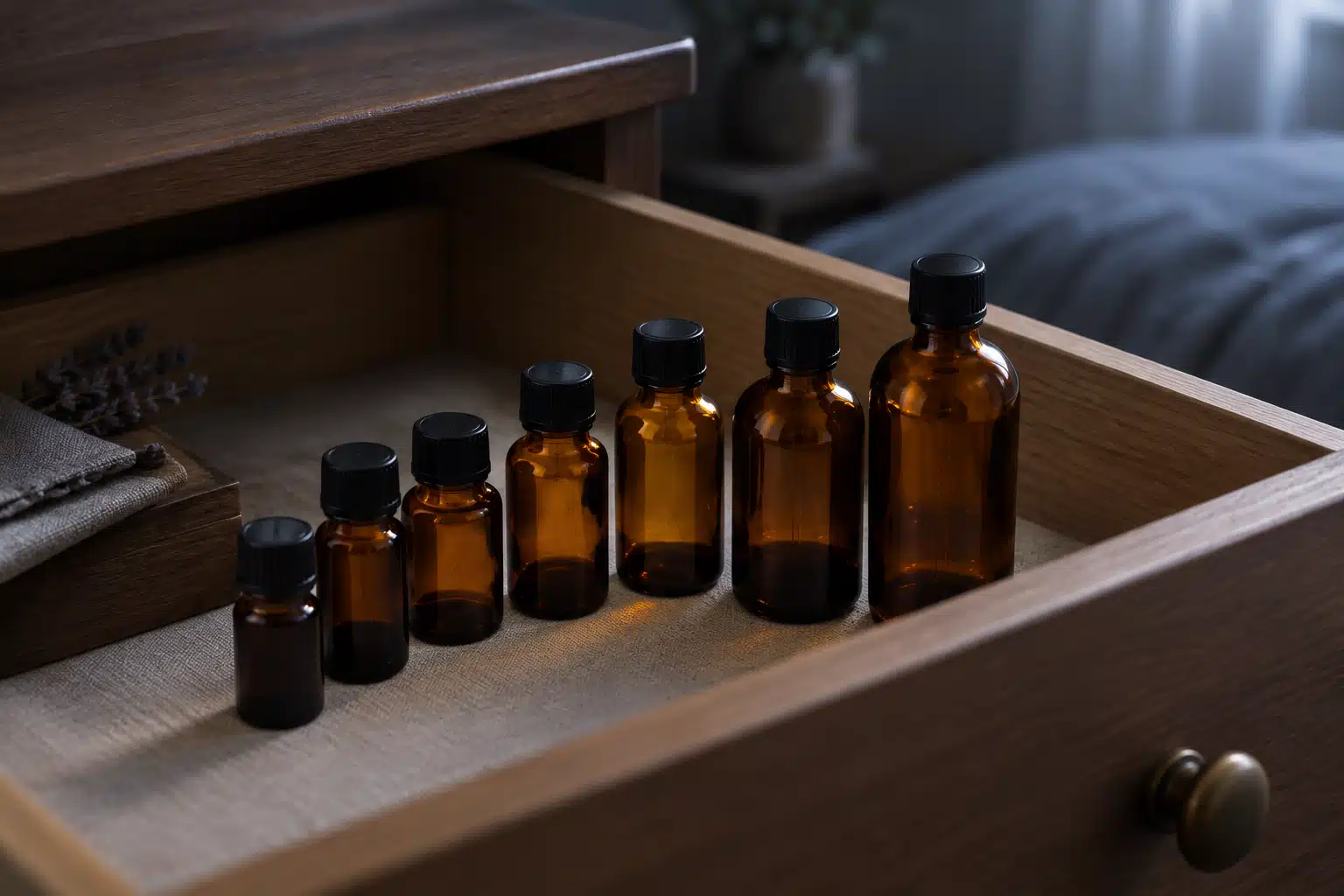
What about storing perfume in the fridge? While it sounds intuitive, it is generally ill-advised for finished blends. Douglas cautions that opening and closing the refrigerator door creates constant micro-fluctuations in temperature. Worse, moving a chilled bottle in and out of room-temperature air pulls moisture inside, causing condensation that can cloud or destabilize your formula. A standard wardrobe or dresser drawer is far more dependable.
One important safety reminder, especially if you also pour candles: 96% ethanol has a flash point of roughly 13 °C and is exceptionally flammable. Always store alcohol-based perfumes and raw perfumer’s alcohol well away from open flames, wax warmers, lit candles, and other heat sources.
Glass, Closures, and Headspace
Amber glass acts as a natural shield, filtering out high-energy UV rays that break chemical bonds. While crystal-clear bottles show off the color of your blend, they belong inside an opaque box or tucked away in a cabinet. If you want a formula to last more than a few weeks, amber glass with a secure cap is by far the most reliable packaging choice.
Always choose glass over plastic for alcohol-based formulations. Glass is practically impermeable to oxygen, whereas plastics like PET and HDPE are subtly porous. Packaging manufacturers note that food-grade PET is suitable only for short-term decants or travel atomizers; while plastic works fine for everyday linen mists, fine perfumes need glass.
-
 €2.44 €198.31Price range: €2.95€2.44 through €239.95€198.31 incl. VAT inc. VATExcl. VATSelect options This product has multiple variants. The options may be chosen on the product page
-
 €0.62 €1.03Price range: €0.75€0.62 through €1.25€1.03 incl. VAT inc. VATExcl. VATSelect options This product has multiple variants. The options may be chosen on the product page


Then comes headspace—the volume of air between the liquid and the cap. The more empty space inside the container, the more oxygen is available to break down the scent. For example, if only 30 ml of perfume remains in a 100 ml bottle, 70 ml of air is actively oxidizing your blend. Decanting that liquid into a snug 30 ml container eliminates nearly all trapped oxygen. When compounding larger batches, decant immediately into multiple small bottles and open them one at a time.
For everyday use, Douglas recommends fine-mist atomizers over splash bottles. A crimped or tightly threaded spray mechanism minimizes exposure to the ambient atmosphere, whereas open bottles invite air inside every time they are splashed. If you prefer dropper bottles, recap them immediately after dispensing.
Storing Raw Materials (Especially Citrus Oils)
Before raw ingredients ever make it into a perfume, they are at their most vulnerable. Cold-pressed citrus essential oils, for instance, consist largely of limonene—a Belgian monograph notes concentrations between 50% and 75% in pure lemon oil. When exposed to air over extended periods, limonene oxidizes into hydroperoxides, potent skin sensitizers that can trigger allergic contact dermatitis. The same monograph observed noticeable oxidation within 10 to 20 weeks at room temperature, whereas cold, dark storage in airtight containers held oxidation at bay for up to a full year without added preservatives.
To protect your blending materials:
- Keep opened citrus oils in tightly capped, small glass bottles in the refrigerator. While not mandatory for every botanical, essential oil suppliers strongly endorse refrigeration for cold-pressed citrus.
- Record the date of opening directly on the bottle, aiming to use citrus oils within 12 to 24 months.
- Downsize partially used bottles into smaller vials to eliminate headspace.
Interestingly, research indicates that limonene remains remarkably stable in a finished eau de toilette—even when stored in half-empty bottles opened regularly over nine months. Dilution in perfumer’s alcohol buffers against the rapid oxidation seen in pure oils. The true vulnerability usually lies with that half-empty bottle of raw essential oil forgotten in the back of your studio.
Treat your fragrance oils and perfume bases with the same care: seal them tightly, keep them out of the light, and always mark their opening dates.
Shelf Life: Alcohol-Based vs. Oil-Based Perfumes
Alcohol-based perfumes do not carry a rigid expiration date; their lifespan depends entirely on the stability of the aromatic materials and how well they are stored. Commercial fine fragrances are generally expected to retain peak quality for one to three years after opening. Because artisanal, homemade perfumes skip industrial stabilization and accelerated shelf-life testing, it is prudent to plan around the lower end of that spectrum. To make sure you are working with the best foundation, consult our guide to perfume alcohol, or pick up high-grade perfumer’s alcohol directly from our collection.
Oil-based roll-ons (using carriers like jojoba or fractionated coconut oil) behave very differently. While pure carrier oils often boast a manufacturer shelf life of 24 months or more, no published studies guarantee that timeline once active botanicals and fragrance compounds are introduced. A practical rule of thumb is to use oil-based blends within 6 to 12 months. This is an experiential guideline rather than a laboratory guarantee, but it helps ensure you enjoy the fragrance before the carrier turns stale.
To extend the freshness of carrier oils, you can add an antioxidant such as vitamin E (tocopherol). Cosmetic formulation literature typically recommends an inclusion rate of 0.05% to 0.5%, depending on the carrier oil’s susceptibility to rancidity. Blend your antioxidants into the oil base at temperatures under 40 °C to preserve their efficacy. Remember, vitamin E slows rancidity; it cannot compensate for improper storage. For deeper insight into oil mediums, browse our guide to making alcohol-free perfume.
Maceration: Why Patience Pays Off
Once you blend your fragrance concentrate with perfumer’s alcohol, the solution needs time to marry. This resting phase—known as maceration—allows individual aroma chemicals to harmonize, softening the sharp, medicinal bite of freshly mixed ethanol. The time required depends on the complexity of your formula:
- Fresh, citrus-heavy formulas: 1 to 2 weeks (prolonged aging can actually dull effervescent citrus notes).
- Floral compositions: 3 to 4 weeks.
- Deep, woody, amber, or resinous profiles: 4 to 8 weeks, or longer.
Keep macerating vessels in the same environment you would keep finished bottles: dark, cool, and undisturbed. If you want to refine your composition skills, explore our guides on the fragrance pyramid and perfume concentration and dilution.
Signs That a Perfume Has Turned
You do not need a lab to spot a spoiled fragrance—your senses will tell you everything. First, observe the color: if a clear or pale liquid turns murky, clouds over, or darkens substantially, chemical breakdown is underway. Second, trust your nose: if the scent smells sour, stale, acrid, or distinctly different from its original profile, the top notes have likely collapsed.
When assessing an older batch, always test it on a paper blotter rather than bare skin. Oxidized botanical compounds, particularly degraded terpenes from citrus and pine, can trigger contact dermatitis. If a batch smells off, discard it without hesitation; blending a fresh bottle is far easier and safer than dealing with a skin reaction.
Selling Your Perfume? Regulatory Requirements
The storage and shelf-life guidance above applies to fragrances blended for personal enjoyment. If you intend to sell your creations commercially or distribute them to the public within the European Union, you must comply with EU Cosmetics Regulation (EC) No 1223/2009 alongside national enforcement bodies such as the NVWA (Netherlands Food and Consumer Product Safety Authority) and guidelines outlined on business.gov.nl. These rules mandate that an accredited safety assessor evaluate your recipe and issue a Cosmetic Product Safety Report (CPSR) before any unit reaches a customer. Every commercial cosmetic must also be registered on the EU Cosmetic Product Notification Portal (CPNP).
If your finished product has a shelf life of 30 months or less, your packaging must feature an explicit “best used before end of” date (indicating month and year). If stability testing confirms a shelf life exceeding 30 months, you must instead print the open-jar symbol (Period After Opening, or PAO), indicating the number of months the product remains safe once unsealed. You can streamline this compliance process through our perfume safety assessment service.

The Golden Rules of Fragrance Preservation
Preserving your handcrafted perfumes comes down to a simple formula: cool temperatures, zero light, airtight seals, and minimal air inside the bottle. Add dates to your labels, decant larger batches into smaller containers, and let your blends rest properly.
When you are ready to craft your next signature scent, follow our step-by-step tutorial on making eau de toilette to mix a balanced 100 ml bottle, and discover our selection of premium perfume bottles to house your work.


