
Sodium citrate appears on far more ingredient decks than you might expect—typically tucked away near the middle or end of the label with little explanation. As the sodium salt of citric acid, it serves two critical purposes in cosmetic formulations: it stabilizes pH and chelates dissolved mineral ions in water. For cold process soap makers, this translates directly into richer lather and far less soap scum in hard water. In leave-on lotions and serums, it keeps delicate formulations within a stable, skin-compatible pH range.
Here is a complete look at what sodium citrate is, how to calculate your usage rates, when you actually need it, and what cosmetic safety panels say about formulating with it.
| Function | What it does | Common applications |
|---|---|---|
| Buffer (pH stabilizer) | Resists pH shifts when an acid or base is introduced | Serums, shampoos, liquid soaps |
| Chelator | Binds calcium, magnesium, and trace metal ions | Bar soaps, shampoos, micellar waters |
| Masking agent | Neutralizes inherent base odors from raw ingredients | A wide range of personal care products |
What Is Sodium Citrate?
Sodium citrate is the trisodium salt of citric acid. According to the Cosmetic Ingredient Review (CIR)—an independent panel evaluating cosmetic safety—it is manufactured by neutralizing citric acid with either sodium hydroxide or sodium carbonate. You will see it declared on ingredient lists under the INCI name Sodium Citrate. In the food industry, it is designated as additive E331.
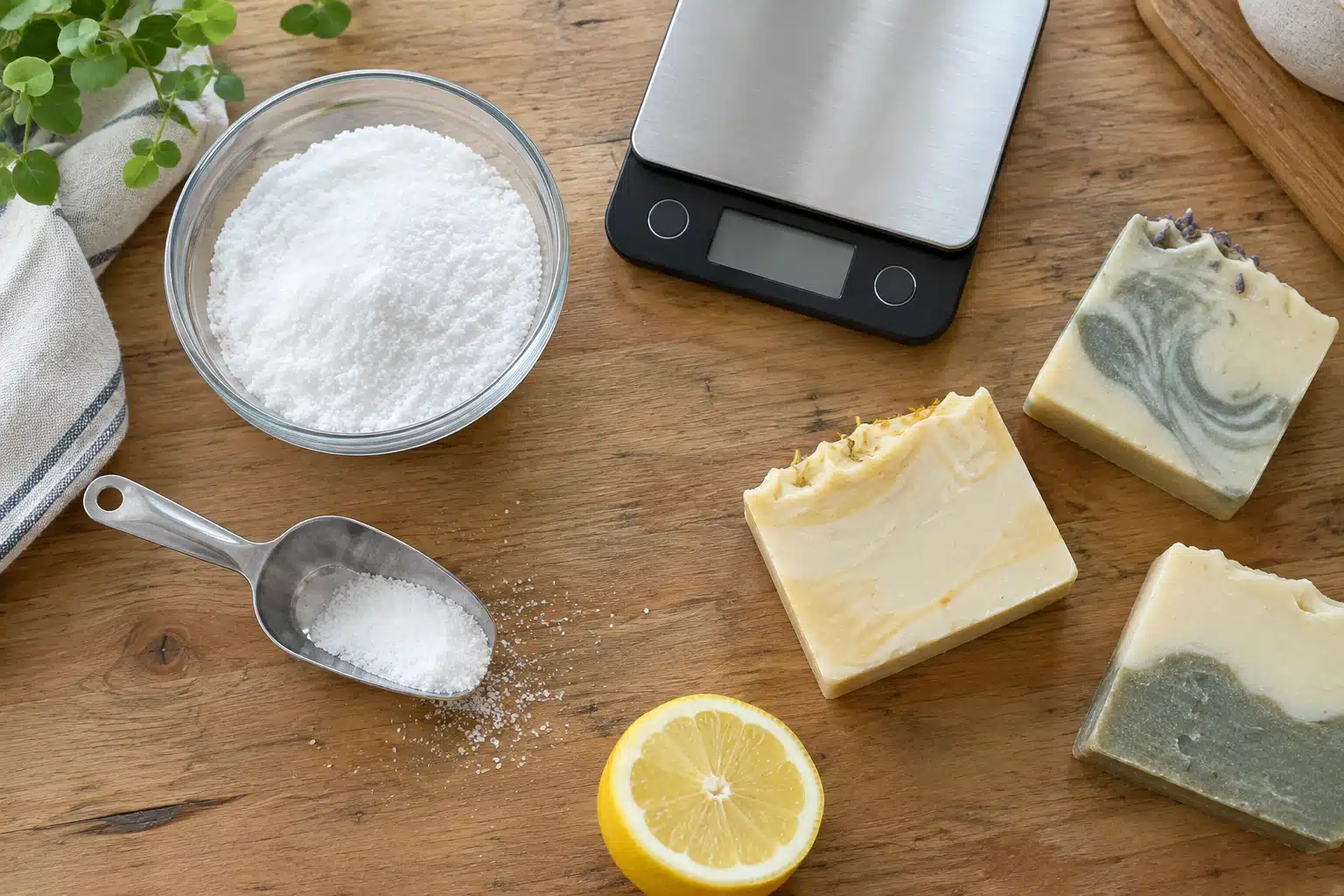
Physically, sodium citrate is an odorless, white crystalline powder that dissolves effortlessly in water. Because it is slightly hygroscopic (readily absorbing moisture from the air, as noted by PubChem), it should always be stored in a tightly sealed, airtight container to prevent clumping.
How It Works in Cosmetics
According to CosIng, the European Commission’s cosmetic ingredient database, sodium citrate fulfills three recognized functions: buffering, chelating, and masking. For formulators, the first two are by far the most valuable.
Buffering: Locking in pH Stability
A buffer prevents a formulation’s pH from drifting when exposed to acidic or alkaline ingredients. Sodium citrate works alongside citric acid to create a citrate buffer system. Together, they establish a reliable buffering zone between roughly pH 3.0 and 6.2—the exact physiological range desired for most skin and hair care products.
On its own, sodium citrate is mildly alkaline; PubChem notes that a 5% aqueous solution yields a pH between 7.5 and 9.0. If your goal is to lower a product’s pH, you must use citric acid. Sodium citrate serves as its stabilizing partner, locking that target value in place. To dial in your formulations with precision, see our guide on measuring the pH of soap.
Chelating: Deactivating Problem Minerals
Citrate molecules feature three carboxyl groups—often visualized as chemical “claws,” as formulation resource Classic Bells describes them—that seize and bind free metal ions. In cosmetics, this chelating action traps trace minerals found in tap water or raw ingredients that would otherwise trigger oxidation, cause off-colors, or spoil delicate botanical oils. Industry portal Cosmeticsinfo highlights this exact mechanism as a primary way citrates bolster product stability and shelf life.
Keep in mind that while a chelating agent improves preservative efficacy by stressing bacterial cell walls, it is never a substitute for a true preservative. Any formulation containing free water still requires a verified broad-spectrum preservative system.
Sodium Citrate in Soap Making: Why Formulators Use It
Natural bar soap and hard water are notoriously incompatible. Dissolved calcium and magnesium ions in tap water bind to soap molecules, converting them into an insoluble, sticky precipitate: soap scum. A chelator captures a significant portion of these minerals before they can react with your soap. Classic Bells notes that while chelation dramatically reduces soap scum and restores lather volume, it is not a complete cure for extreme water hardness.
Regional water hardness plays a major role in how noticeable these benefits will be. For example, Dutch water authority Waternet estimates the national average at approximately 8 °dH, categorizing anything above 12 °dH as hard water. Levels vary substantially by area: southern provinces such as Noord-Brabant and Limburg consistently register some of the hardest tap water in the Netherlands. Soapers formulating or selling in hard-water regions will see an immediate, dramatic improvement by adding a chelator.
Usage Rates in Cold Process Soap
Classic Bells recommends a baseline rate of 13 to 39 grams of sodium citrate per 1,000 grams of batch oils (1.3% to 3.9% of total oil weight). Use the lower end of that range for softer municipal water and scale toward the top end for hard water. Here is a simple formulation example:
- Your recipe calls for 500 g of oils.
- At 1.3%, measure out 6.5 g of sodium citrate; at 3.9%, measure out 19.5 g.
- Dissolve the powder in roughly twice its weight in water (13 to 39 g), then blend this concentrated solution directly into your warm oils before introducing your lye, following the method outlined by Classic Bells.
Two critical rules to keep in mind:
- You do not need to adjust your lye calculation. Because sodium citrate is already fully neutralized, it does not consume sodium hydroxide. Citric acid, on the other hand, does: Soapformulator notes that every 10 g of citric acid neutralizes roughly 6.2 g of NaOH. If you formulate with citric acid instead, read our guide on calculating your lye solution first to avoid an unintended, heavy superfat.
- More is not better. Classic Bells warns that excessive sodium citrate can precipitate out onto the surface of the finished bar, creating a dusting of white salt crystals. Ideal usage rates also vary by formulation goal: Modern Soapmaking utilized 3% in bench tests to maximize lather, whereas Kevin Dunn’s research on dreaded orange spots (DOS) used just 0.1% of oil weight purely for antioxidant chelating benefits. Start low and test your results.
In bench trials conducted by Modern Soapmaking, soap formulated with 3% sodium citrate yielded noticeably denser, faster lathering bars than unchelated controls. By tying up hardness minerals, more soap molecules remain free to foam.
Liquid Soap and Melt & Pour
For liquid soap paste, dissolve sodium citrate directly into your batch water before blending in potassium hydroxide. Community recommendations range from 1.3% up to roughly 4% of oil weight, though raw ingredient suppliers often suggest a more conservative 0.1% to 0.5%. We recommend starting on the lower end to observe clarity and viscosity. For foundational techniques, read our walkthrough on making liquid soap.
In melt and pour soap crafting, sodium citrate can be incorporated smoothly into melted bases. In our strawberry melt and pour recipe, for example, we dissolve 10 g of sodium citrate into 500 g of base (a 2% usage rate).
Sodium Citrate in Lotions, Serums, and Shampoos
Outside the soap pot, sodium citrate shines as a buffer and trace metal scavenger. In our DIY vitamin C serum formula, it stabilizes a sensitive active ingredient alongside the following components: 5% glycerin, 1% hyaluronic acid, 89% deionized water, 1% sodium citrate, 1% Cosgard 221, and 3% sodium ascorbyl phosphate (SAP).
When formulating solid shampoo bars, hair health demands an acidic target pH between 4.5 and 5.5. If your initial batch tests on the basic side, adjusting with a pinch of citric acid brings it down, while sodium citrate locks that reading in place over time. For more tips on balancing solid hair care, explore our step-by-step guide to making a shampoo bar.
Recommended Usage Rates at a Glance
| Application | Typical usage rate | Source |
|---|---|---|
| Cold process soap | 1.3% to 3.9% of oil weight | Classic Bells |
| Liquid soap | 0.1% to ~4% (wide range) | Formulator forums, chemical suppliers |
| Soap and shampoo (our catalog guidelines) | Under 1% | YouWish |
| Skincare (our catalog guidelines) | Up to 5%–10% | YouWish |
| Maximum reported in cosmetics | Up to 10% | CIR |
Treat the 5% to 10% skincare range as an absolute ceiling, representative of the highest concentrations documented in CIR safety surveys. In practice, leave-on formulations rarely require more than 1% to achieve full buffering and chelating efficacy.
Safety and Regulatory Profile
The CIR Expert Panel concluded that sodium citrate is safe for cosmetic use under current industry practices. Documented concentrations range from 0.000005% up to 10% across both leave-on formulas and rinse-off cleansers, including concentrations around 0.9% in bath products and 0.5% to 2% in eye makeup removers. Clinical patch tests reviewed by the CIR showed that even a 10% aqueous solution produced zero immediate, non-immunologic contact urticarial reactions across 49 atopic subjects.
Individual skin tolerances can always vary, making small patch tests standard best practice when rolling out new recipes. If you manufacture cosmetics for retail, confirm that Sodium Citrate is declared correctly on your packaging. For complete regulatory requirements, consult our reference on cosmetic INCI names.
Formulation Mistakes to Avoid
- Confusing sodium citrate with citric acid. Citric acid consumes active lye; sodium citrate does not. Swapping one for the other without recalculating will ruin your batch’s saponification balance.
- Overdosing in cold process soap. Adding more than 4% can cause white salt crystals to bloom on the bar’s exterior without offering any additional performance gains.
- Expecting zero soap scum. Sodium citrate drastically reduces residue, but it cannot entirely eliminate buildup in areas with exceptionally high mineral content.
- Relying on it as a preservative. While it deprives microbes of the trace metals they need to thrive, it lacks the antimicrobial strength to preserve an unpreserved water-based product.
- Leaving powder containers open. Sodium citrate pulls ambient moisture straight out of humid air; leave the lid off, and your fine powder will turn into a solid block.
Sourcing and Working with Sodium Citrate
Whether you want to eliminate soap scum in your bars or stabilize an antioxidant facial serum, sodium citrate is one of the most cost-effective additives in a formulator’s toolkit. YouWish supplies high-purity sodium citrate in convenient sizes ranging from 100 g and 250 g sample bags up to 5 kg and 25 kg workshop buckets. Try adding 1.3% to your next cold process batch, compare the lather against your standard recipe, and adjust upward if your local tap water runs hard.
-
 €4.92 €578.47Price range: €5.95€4.92 through €699.95€578.47 incl. VAT inc. VATExcl. VATSelect options This product has multiple variants. The options may be chosen on the product page
If you need guidance refining your formulas or calculating masterbatches, browse our complete library on soap making or join us in person for one of our hands-on workshops.


