
Pressing a test strip against a dry bar of soap is a surefire way to get an inaccurate reading. Because pH can only be measured in an aqueous solution, you must first dissolve the soap in water before testing it.
Here is the quick method: shave 1 gram of soap from the center of the bar, dissolve it in 9 grams of distilled water to make a 10% solution, let it cool to room temperature, and test it with a calibrated digital pH meter or high-precision test strips. A properly formulated, fully cured cold process bar typically tests between pH 8 and 10. A reading of 12 or above is an immediate red flag that unreacted, free lye remains in the bar.
However, many soapmakers misunderstand what this reading actually reveals. While testing your soap’s pH confirms whether it falls within a skin-safe range, a normal reading does not prove the bar is completely free of lye. Here is why—and what you should do instead.
| Method | What It Measures | Best Suited For |
|---|---|---|
| Zap test (tongue) | Gross excess lye at a single contact point | Not recommended |
| pH test strips | Approximate pH via color change (wide margin of error) | Quick checks of liquid soap or diluted solutions |
| Digital pH meter | Precise decimal pH reading (requires routine calibration) | Batch tracking and recipe formulation |
| Laboratory titration | Exact percentage of free caustic alkali | Commercial production and regulatory compliance |
Why Soap pH Matters
Human skin is naturally acidic. Its protective acid mantle sits between pH 4.5 and 5.5, shielding the body against moisture loss and opportunistic pathogens. True soap, by contrast, is an alkaline salt produced by the chemical reaction between fats and a strong base (saponification). True soap cannot chemically exist at a skin-neutral pH of 5.
This alkaline profile directly affects the skin. In one study of ten infants, washing with alkaline soap (pH 9.5) raised skin surface pH by an average of 0.45 units, compared to an increase of just 0.19 units with plain tap water. Another study tracking healthy adults washing their forearms over seven days found that alkaline soap increased transepidermal water loss and caused noticeable erythema (redness). Mildness is not a simple pass/fail metric; it exists on a spectrum. If a new batch leaves your skin feeling tight or stripped, pH is one of the first variables to check—though not the only one (for more on this, see our guide on skin irritation from soap).
If you sell your soap, pH is also an essential quality parameter. Handcrafted soap sold in the EU and UK falls under European Cosmetics Regulation (EC) No 1223/2009. To complete your Cosmetic Product Safety Report (CPSR), you must document the physical and chemical specifications of the finished product. Official guidelines specifically cite pH and acceptable tolerance ranges as examples of required release specifications. To learn more about meeting these standards, read our guide on handcrafted soap safety and CPSR requirements.
Expected pH Ranges by Soap Type
Different soapmaking methods yield different baseline ranges. The benchmarks below reflect technical literature and raw material specifications. Treat them as operational targets rather than absolute cutoffs:
- Cold process soap: Typically 8 to 10, though some recipes reach 11. High-olive-oil bars (such as Castile) generally test slightly higher than high-coconut-oil bars.
- Melt and pour soap base: Usually 9 to 10.5 in a 1% solution. Stephenson, a major specialty base manufacturer, specifies a range of 9.5 to 10.5 and notes that acidifying the base will break down the soap structure.
- Liquid soap (potassium hydroxide): Typically adjusted to pH 9 to 10, though broader commercial specifications accept ranges from 8 to 11.
- Syndet bars and shampoo bars: These are synthetic detergent bars made with mild surfactants rather than saponified oils. Syndet bars typically sit between pH 5.5 and 7.0, with modern formulations matching the skin’s natural mantle at 5.0 to 5.5.
If your priority is a product formulated at the skin’s natural pH, do not try to acidify traditional cold process soap. Instead, formulate with a syndet base, such as the Syndopour Shampoo melt and pour base. Learn more in our articles on pH-neutral soap and how to make shampoo bars.

Zap Test, Strips, or Meter: Which Should You Use?
The zap test is the traditional folk method of touching the tip of your tongue to a cured bar. A sharp, electric sting—reminiscent of touching a 9-volt battery—signals unreacted lye. While seasoned soapmakers often rely on it, we advise against it. Placing unreacted caustic material against sensitive mucous membranes is an unnecessary safety hazard. More importantly, the test only checks the specific surface area touched by your tongue; it cannot detect localized lye pockets hidden deeper in the bar.
pH test strips offer a fast, inexpensive screening method for liquid soap or diluted solutions. However, they are notoriously difficult to read accurately with solid soap. Distinguishing subtle color shifts in the alkaline 8–11 range is challenging, and cheap universal test strips frequently under-read by 2 to 3 full units when checked against a calibrated laboratory meter. If you use test strips, choose narrow-range options (such as pH 7–11); broad-spectrum 0–14 strips lack the resolution needed for safety assessments.
A digital pH meter delivers clear numerical readouts down to two decimal places. However, that precision is only as good as your calibration routine. An uncalibrated digital meter generates an authoritative-looking number that may be entirely wrong—creating a false sense of security that is far riskier than using test strips. If you use a digital meter, calibrate it regularly with fresh buffer solutions and store the glass electrode in proper storage solution.
Even with precision instruments, there is a fundamental limitation to keep in mind: what does a pH reading actually prove about lye safety?
Why pH Does Not Prove Your Soap Is Lye-Free
This is where standard soapmaking advice frequently falls short. Properly saponified soap naturally tests between pH 9 and 10, and a batch with a slight excess of lye will only read marginally higher.
In soap chemistry, an excess of 0.1% (one part per thousand) free lye shifts the solution’s pH upward by only roughly 0.3 units. That subtle shift is smaller than the natural baseline variance between an olive oil bar and a coconut oil bar. A reading of 9.8 is no guarantee that your soap is completely lye-free.
Here is how to interpret your results responsibly:
- A pH of 12 or higher is an absolute failure threshold that confirms the presence of unreacted free lye.
- A reading between 8 and 10 indicates that the soap is within the expected alkaline range, but it is not definitive proof of safety. A lye-heavy bar cured over several months can develop a neutral surface reading because atmospheric carbon dioxide reacts with surface lye to form harmless sodium carbonate.
- Chemical titration is the gold standard used by testing laboratories. Commercial standards regulate the maximum allowable percentage of free caustic alkali, not pH alone. Because acid-base titration requires analytical glassware and reagents, commercial makers typically outsource this testing.
- Meticulous formulation is your most reliable safeguard against caustic soap. Always verify recipes using an established lye calculator, weigh every ingredient on a precise digital scale, and include a deliberate superfat (lye discount). For step-by-step math, see our guide on calculating lye and water ratios.
View pH testing as a quality assurance tool that tracks consistency across batches, rather than a substitute for good formulation habits.
How to Measure Soap pH in a Solution: Step by Step
Both digital probes and test strips measure the activity of free hydrogen and hydroxide ions. Because ions cannot move through dry soap, you must create a uniform liquid solution. Follow this standard testing protocol:
- Let the soap cure completely. Cold process soap requires a full four to six weeks to cure (see our breakdown of soap curing times). Testing fresh bars directly from the mold yields unreliable readings because active saponification is still taking place.
- Sample from the core. Cut or grate a small sample from the center of the bar, not the outer surface. Air exposure and carbonation alter the chemistry of the exterior rind, creating misleading readings.
- Prepare a 10% solution. Weigh 1 gram of grated soap and combine it with 9 grams of distilled water. Never use tap water; dissolved minerals and variable municipal pH will distort the results. Use high-purity distilled or demineralized water (or prepare your own using our distilled water guide for cosmetics). You can test solutions ranging from 1% to 10%, but pick one standard ratio and stick to it so your batch records remain comparable over time.
- Dissolve the sample gently. Stir slowly to avoid creating lather. A thick layer of foam can trap air bubbles against the meter’s glass bulb, disrupting the reading. Dense, well-cured bars take time to break down; laboratory protocols often let 10% soap solutions stand for several hours or overnight to reach chemical equilibrium.
- Standardize the temperature. Let the solution reach room temperature (around 20–25 °C / 68–77 °F) and record the temperature alongside your reading. Solution pH changes with temperature due to shifts in ion dissociation. A measurement taken at 15 °C cannot be directly compared to one taken at 25 °C.
- Take the reading. Submerge the probe or test strip into the liquid until the reading stabilizes. If using test strips, dip the strip for approximately one second, shake off excess liquid, and compare it to the color chart within the exact timeframe listed on the packaging.
- Log your results. Record the batch number, dilution ratio, temperature, date, and final pH. Consistent documentation is essential for quality control and building a compliant Product Information File (PIF).
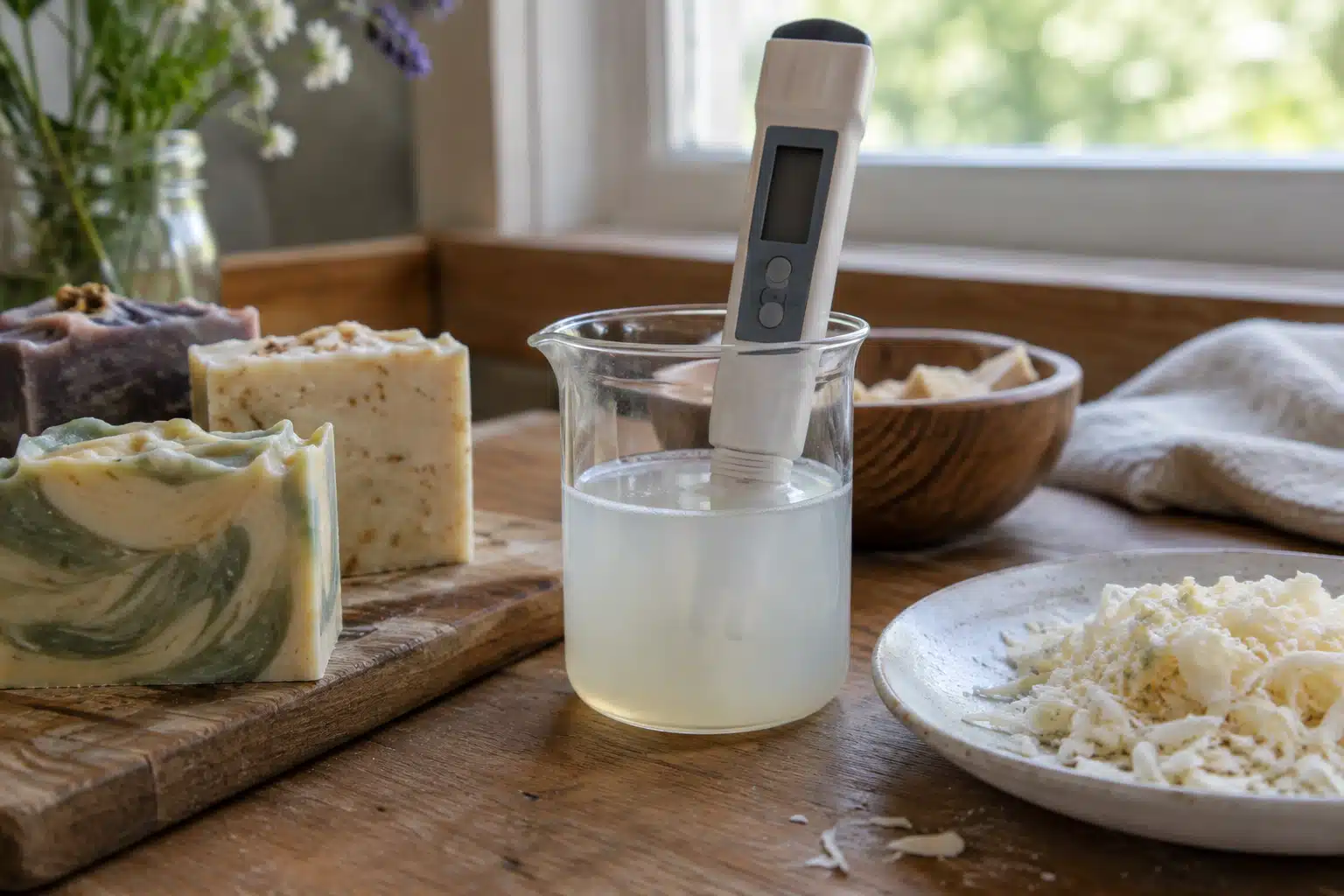
For example: a 10% solution reading 9.6 at 21 °C indicates a normal, well-balanced cold process bar. If that same batch reads 12.1, set it aside immediately and review your recipe calculations. If it reads 7.8, recalibrate your meter before assuming something went wrong with the soap.
Calibrating and Storing Your pH Meter
Always calibrate your meter using reference buffer solutions that bracket your expected testing range. Since soap solutions fall between 9 and 10, perform a two-point calibration using pH 7.00 and pH 10.01 buffers. Ensure the buffers are at room temperature, pour out small individual portions for testing rather than inserting probes directly into the stock bottles, and rinse the probe with distilled water between measurements.
Always store the sensitive glass electrode in dedicated 3M KCl electrode storage solution. Never store the probe in distilled water, and never let the glass bulb dry out, as this permanently damages the hydration layer.
To keep your equipment accurate, our digital pH meter calibration buffer powder makes routine calibration straightforward and reliable.

Troubleshooting Abnormal pH Readings
Cold process soap testing significantly high (pH 12+): Quarantine the entire batch immediately. Do not use, give away, or sell it. A reading at or above 12 indicates unreacted free lye, typically caused by a scale malfunction, miscalculated recipe, or insufficient mixing. Do not attempt to fix finished bars by soaking them in vinegar or citric acid; topical acid simply breaks down the exterior soap molecules into free fatty acids, ruining the texture without neutralizing internal lye pockets. The only viable remedy is rebatching: shred the soap, calculate and add the required supplemental oil, cook the mixture until full saponification is achieved, and re-test after curing.
Liquid soap testing too high: Unlike bar soap, liquid soap paste can be neutralized with a diluted acid solution. However, proceed with care. Citric acid only neutralizes excess potassium hydroxide; adding too much acid will break down the soap molecules into insoluble free fatty acids, leaving the liquid cloudy or separated. Prepare a 20% citric acid solution in distilled water, add it in small increments, stir thoroughly, and check the pH after each addition. Learn more in our guide on making liquid soap with natural ingredients.
-
 €7.95 €144.59Price range: €7.95€7.95 through €174.95€144.59 incl. VAT inc. VATExcl. VATSelect options This product has multiple variants. The options may be chosen on the product page

A pH reading that seems unusually low: Recalibrate your instrument before discarding the batch. In almost every case, a surprisingly low reading is caused by an expired test strip or a drifted meter calibration, rather than true soap failing to reach its natural alkaline state.
Integrating pH Testing into Your Production Workflow
A single test provides a snapshot; a systematic batch log provides actionable insight. Testing every batch under standardized conditions—using the same cure time, dilution ratio, and testing equipment—establishes a dependable baseline for each formula and makes rogue batches immediately obvious.
If you produce soap commercially, professional lab verification can streamline your compliance workflow. We offer a comprehensive Product Specification Report that formally validates the pH and technical specifications of your cosmetic products. If you are new to the craft, our beginner’s guide to cold process soap making covers every step of safe production. And when you are ready to prepare your next batch, explore our selection of high-grade soap making supplies.


