
Just half a gram of excess lye can turn a nourishing bar of handmade soap into an irritating skin hazard. Fortunately, calculating your lye water comes down to just three factors: the weight of your oils, their individual saponification (SAP) values, and your chosen superfat percentage. Once you determine your lye amount, you calculate your water based on that lye—never as an arbitrary percentage of the oils.
Below, we break down the math step by step using a 1 kg batch of oils as a worked example, followed by essential safety guidelines every soapmaker must follow.
The process in four steps:
- Weigh your oils and multiply each oil’s weight by its NaOH SAP value. Sum the results to find your base lye requirement.
- Apply your superfat discount (for example, multiply the total by 0.95 for a 5% superfat).
- Select your target lye concentration (typically 33%) to calculate the required water.
- Always add the lye crystals slowly into the water—never pour water onto dry lye.
SAP Values: How Much Lye Each Oil Requires
Every oil, fat, and butter requires a precise amount of lye to undergo complete saponification. This requirement is defined by its saponification value, commonly called the SAP value. For solid bar soaps, use sodium hydroxide (NaOH); for liquid soaps, use potassium hydroxide (KOH).
Pay close attention to units, as reference charts handle them differently. For NaOH bar soap, the SAP value represents the grams of lye required per gram of oil. Olive oil, for instance, has an average SAP value of 0.135, meaning 100 g of olive oil requires 13.5 g of NaOH. Scientific and laboratory reference tables often report SAP values in milligrams of KOH per gram of oil (roughly 190 mg/g for olive oil). Dividing that laboratory figure by approximately 1,400 yields the equivalent NaOH value in grams.
| Oil or Butter | NaOH per Gram of Oil | Variance Across Sources |
|---|---|---|
| Olive oil | 0.135 | 0.134 to 0.135 |
| Coconut oil (76°) | 0.183 | 0.178 to 0.190 |
| Palm oil | 0.142 | 0.141 to 0.142 |
| Castor oil | 0.128 | 0.128 to 0.129 |
| Shea butter | 0.128 | 0.128 |
Natural oils vary naturally depending on growing conditions, harvest timing, and processing methods, which explains why different soap calculators display slight discrepancies. Pick one reputable calculator or reference chart and remain consistent throughout your formulation. Coconut oil exhibits the widest spread in values; when precision matters, refer directly to your supplier’s certificate of analysis or specification sheet.
Superfatting: Intentionally Using Less Lye
Superfatting—also called taking a lye discount—means formulating with less lye than chemically needed to saponify every fatty acid molecule. This intentional deficit leaves a small percentage of unreacted oils free in the cured bar, creating a gentler, more moisturizing lather while providing a vital margin of error if your digital scale is off by a fraction of a gram. A 5% superfat means you use 5% less lye, multiplying your theoretical requirement by 0.95.
Recommended superfat ranges by application:
- Body soap: 5% serves as the reliable industry standard.
- Facial soap: 5% to 8%, with gentle recipes occasionally reaching 10%.
- Shampoo bars: 0% to 3%, minimizing heavy residual buildup on hair strands.
- Laundry soap: Guidelines vary. Formulations designed for grated laundry flakes often use 0% to 3% to maximize cleaning power, whereas specialized stain-stick bars made from 100% coconut oil sometimes call for 15% to 20% to balance coconut’s harsh cleansing profile. For cleaning soaps, always stick to a tested formula.
Superfatting above 10% can leave bars overly soft and prone to oxidation, commonly known as dreaded orange spots (DOS). However, free unreacted oils are not the sole culprit—controlled experiments show that zero-superfat olive oil soaps can still develop DOS under poor conditions. Proper curing and storage are critical; review our guide on storing soap and shelf life for best practices. Using a chelator such as sodium citrate can also help by binding the trace metal ions that initiate rancidity.
-
 €4.92 €699.95Price range: €5.95€4.92 through €699.95€699.95 incl. VAT inc. VATExcl. VATSelect options This product has multiple variants. The options may be chosen on the product page
Calculation Example: 1 kg Oil Batch
Assume a recipe using 600 g olive oil, 300 g coconut oil, and 100 g castor oil, formulated with a 5% superfat.
- Olive oil: 600 × 0.135 = 81.0 g NaOH
- Coconut oil: 300 × 0.183 = 54.9 g NaOH
- Castor oil: 100 × 0.128 = 12.8 g NaOH
- Base NaOH required for 100% saponification: 148.7 g
- Adjusted for 5% superfat: 148.7 × 0.95 = 141.3 g NaOH
If your lye is not 100% pure, adjust for purity by dividing your final target weight by the decimal purity percentage. For example, if using 99% pure technical-grade NaOH, calculate: 141.3 ÷ 0.99 = 142.7 g. Always verify the purity stated on your chemical container.
Before mixing, enter your oil weights into an established online soap calculator to cross-reference your manual math. If your numbers differ by more than one or two grams, pause and identify the discrepancy before proceeding.
How Much Water Does Your Lye Need?
A common misconception among beginner soapmakers is calculating water as a percentage of the total oils. In modern soap formulation, water should always be calculated relative to your lye. This is expressed as lye concentration: the proportion of lye relative to the total combined weight of the water and lye solution. A 33% lye concentration contains 33 g of lye per 100 g of solution, which translates directly to a 2:1 water-to-lye ratio.
Applying this to our 141.3 g lye requirement:
| Lye Concentration | Water Required for 141.3 g Lye | Best Application |
|---|---|---|
| 25% | 423.9 g | Maximum working time; intricate, multi-colored swirl designs |
| 28% | 363.3 g | Comfortable working pace with moderate mold time |
| 33% | 286.9 g | General-purpose standard for cold process soap |
| 38% | 230.6 g | Steep water discount; accelerates trace significantly |
Formula: `Water = Lye × (100 − Concentration) ÷ Concentration`
Older soap recipes frequently specify water as “38% of oil weight” (380 g water for 1 kg of oil), which yields an unnecessarily dilute lye concentration of roughly 27%. When recreating vintage formulas, convert the water amount into a defined lye concentration to gain better control over your emulsion.
Water Discounting: Benefits and Trade-offs
Using less water than standard is known as water discounting. Reducing the water content yields a firmer bar right out of the mold, allows earlier unmolding, and shortens the curing period—often reducing the initial cure to 3 to 4 weeks instead of 4 to 6 weeks. (Keep in mind that many artisans still prefer a full six-week cure to maximize bar hardness and mildness, regardless of water levels.)
The primary trade-off is speed: lower water content accelerates trace, causing your soap batter to thicken much faster. Highly detailed swirls, funnel pours, and feather patterns require a fluid batter and therefore benefit from a lower lye concentration (more water).
If you are new to water discounting, start conservatively with a 10% water reduction and cap your discount at 15%. Pushing discounts too far risks incomplete lye dissolution. Undissolved lye crystals will form caustic “lye pockets” in the finished soap, which can burn the skin upon contact. When working with aggressive discounts, always pour your dissolved lye solution through a fine stainless steel mesh strainer into your oils.
To explore the underlying chemical reactions in detail, read our guide on cold process soap and the science behind it.
Mixing Lye Safely: Essential Precautions
Sodium hydroxide is an aggressive chemical base classified as Skin Corrosion Category 1A (H314: causes severe skin burns and serious eye damage). While a formulation mistake will ruin a batch of soap, improper lye handling can cause permanent physical injury.
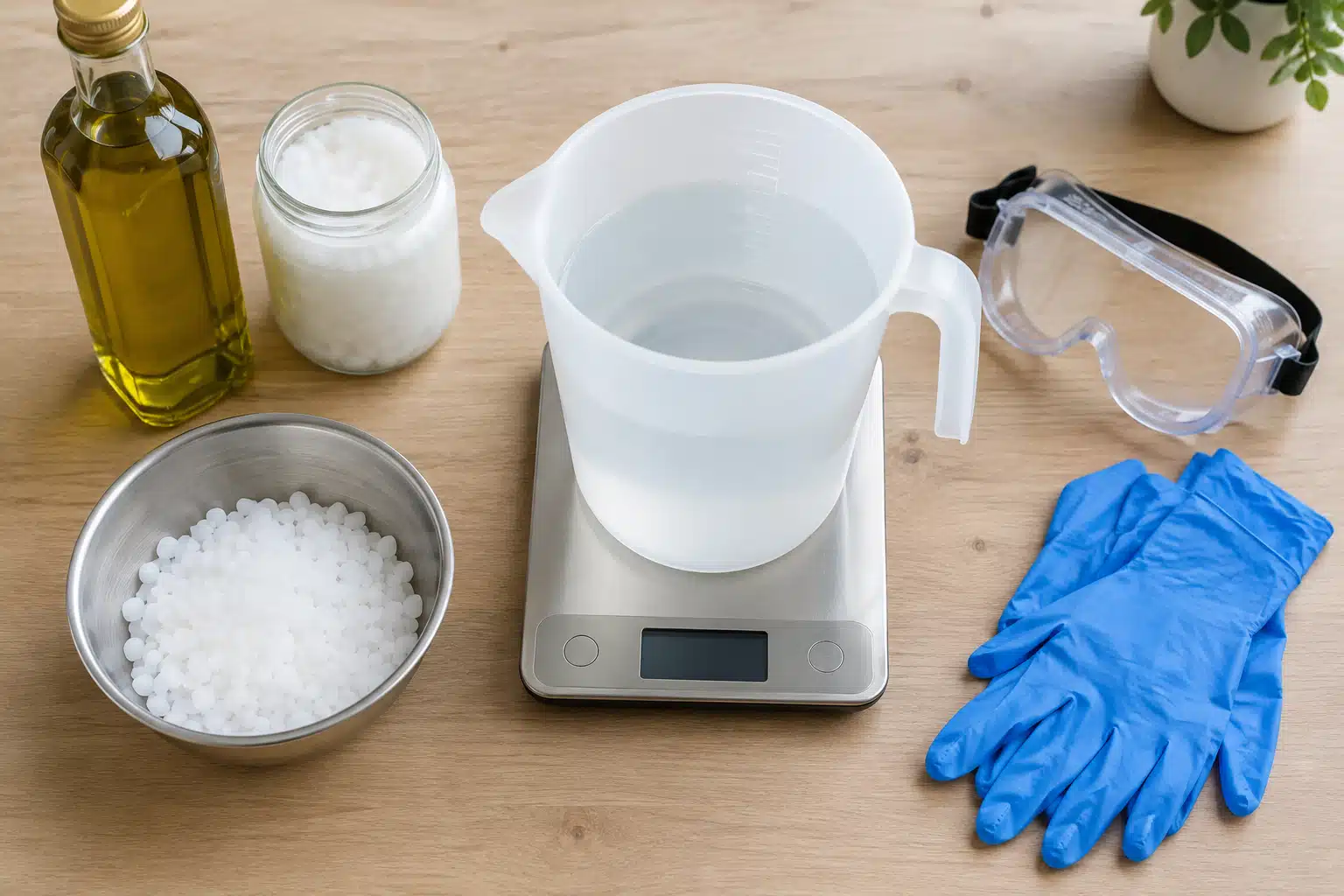
- Always wear wrap-around safety goggles (standard eyeglasses are not sufficient), chemical-resistant nitrile gloves, long pants, long sleeves, and closed-toe shoes.
- Work in a well-ventilated space or directly beside an open window. Dissolving lye releases a sudden plume of caustic steam that must not be inhaled.
- Measure your cold water into a container first, then weigh your lye into a separate dry container. Slowly pour the lye crystals into the water while stirring continuously. Never pour water over dry lye, as this can trigger a violent volcanic reaction that spatters boiling caustic liquid.
- Be prepared for intense heat. As documented by formulation laboratories like The Cosmetics Lab, the exothermic reaction frequently pushes solution temperatures past 75 °C (167 °F).
- Mix exclusively in heat-resistant, lye-safe containers made of heavy-duty plastics (such as HDPE #2 or polypropylene #5) or high-grade stainless steel. Never use glass—thermal shock can cause it to shatter instantly, and lye etches glass over time. Never use aluminum, tin, zinc, or copper; lye rapidly corrodes these metals and produces explosive hydrogen gas.
- Clearly label your lye equipment and ensure pets and children are kept well away from your workspace.
A digital scale with 0.1-gram precision is indispensable, especially for test batches under 1 kg. Dedicate all mixing vessels, spatulas, and immersion blenders exclusively to soapmaking—never return them to food preparation.

If raw lye or fresh batter splashes onto your skin, strip off contaminated clothing immediately and flush the area with copious running tap water. Poison Control guidelines advise flushing for a minimum of 20 minutes; occupational safety organizations such as CCOHS recommend flushing sodium hydroxide exposures for up to 60 minutes. Never pour vinegar on a lye burn. Acid-base neutralization is an exothermic reaction that generates localized heat, worsening the chemical burn with a thermal burn. Seek professional medical evaluation. If lye enters the eyes, flush continuously with clean water for 15 to 20 minutes and contact emergency services immediately.
Source pure, soapmaking-grade sodium hydroxide from reputable chemical distributors and review the manufacturer’s safety data sheet (SDS). For complete safety protocols, consult our detailed walkthrough on soap making for beginners.
Liquid Soap: Adjusting for Potassium Hydroxide
Liquid soap crafting requires potassium hydroxide (KOH) rather than sodium hydroxide. The chemical weight of KOH means its SAP values are approximately 1.403 times higher than those for NaOH.
Purity adjustments are mandatory when working with KOH. Unlike dry NaOH beads, which are typically 98% to 99% pure, cosmetic-grade KOH flakes contain absorbed water and are commonly sold at roughly 90% purity. You must account for this by dividing your calculated KOH amount by its purity factor (e.g., divide by 0.90). Omitting this calculation leaves your recipe approximately 10% lye-deficient, resulting in an oily, separated liquid soap paste.
The initial paste solution is typically mixed at a 25% to 30% KOH concentration before being diluted with hot water after the paste has cooked completely.
For a complete walkthrough of this method, follow our step-by-step guide on making liquid soap with natural ingredients.
Suspect a Lye-Heavy Batch? Skip the “Zap Test”
Older soapmaking books and online forums frequently advocate the traditional “zap test”—touching a moist finger to the soap and touching it to your tongue to detect an electrical “sting.” This practice should be permanently retired. If a batch contains unreacted lye pockets, placing raw caustic soap directly onto delicate oral mucous membranes risks chemical burns.
Safer ways to evaluate a questionable batch:
- Recalculate your formula from scratch using an independent soap calculator to verify your original measurements.
- Allow the soap to complete a full four-to-six-week cure before testing again; unreacted lye often resolves over time as cure-stage saponification finishes.
- Treat standard paper pH test strips with skepticism—they are notoriously unreliable when reading thick soap emulsions.
- Apply a drop of 1% phenolphthalein solution to a freshly sliced cross-section of the bar as a preliminary indicator of free caustic alkalinity.
If you have valid reason to believe a batch is caustic and lacks a balanced cure, the safest protocol is to discard it or rebatch it with extra oil. When in doubt, never use suspect soap on your skin.
Getting Started with Your First Calculation
Select your base oils, note down their SAP values from a single reliable source, set your targets to a 5% superfat and a 33% lye concentration, and work through the calculations above. Working through the math manually builds the foundational understanding you need to formulate with confidence. When you are ready to assemble your equipment and raw oils, explore our full collection of ingredients and tools in our soap making section.


