
While ghee is best known as a culinary staple, it can just as easily serve as a luxurious base for handmade balms and salves. At its core, ghee is simply butter stripped of virtually all its non-fat components: water and milk proteins. What remains is approximately 99.5% pure fat with an impressive smoke point of roughly 250 °C (482 °F). This high thermal stability makes it fantastic in the skillet—and an ultra-rich, velvety emollient for DIY skincare.
That said, it pays to approach the internet’s more extravagant beauty claims with a healthy dose of skepticism. To date, no clinical human trials prove that ghee nourishes or repairs the skin barrier any better than other quality plant or animal fats. Here is a realistic look at what ghee actually is, how to make it at home, how to formulate with it, and who should steer clear.
Ghee vs. Butter: A Side-by-Side Comparison
| Butter | Ghee | |
|---|---|---|
| Fat content | At least 80% | At least 99.5% |
| Moisture content | Up to 16% | Maximum 0.5% |
| Milk protein & lactose | Present | Virtually none |
| Smoke point | Approx. 150–175 °C (300–350 °F) | Approx. 250 °C (482 °F) |
Fat and moisture standards reflect criteria established by the Food Safety and Standards Authority of India (FSSAI). Because reported smoke points vary across literature, regular butter is shown as a range.
What Exactly Is Ghee?
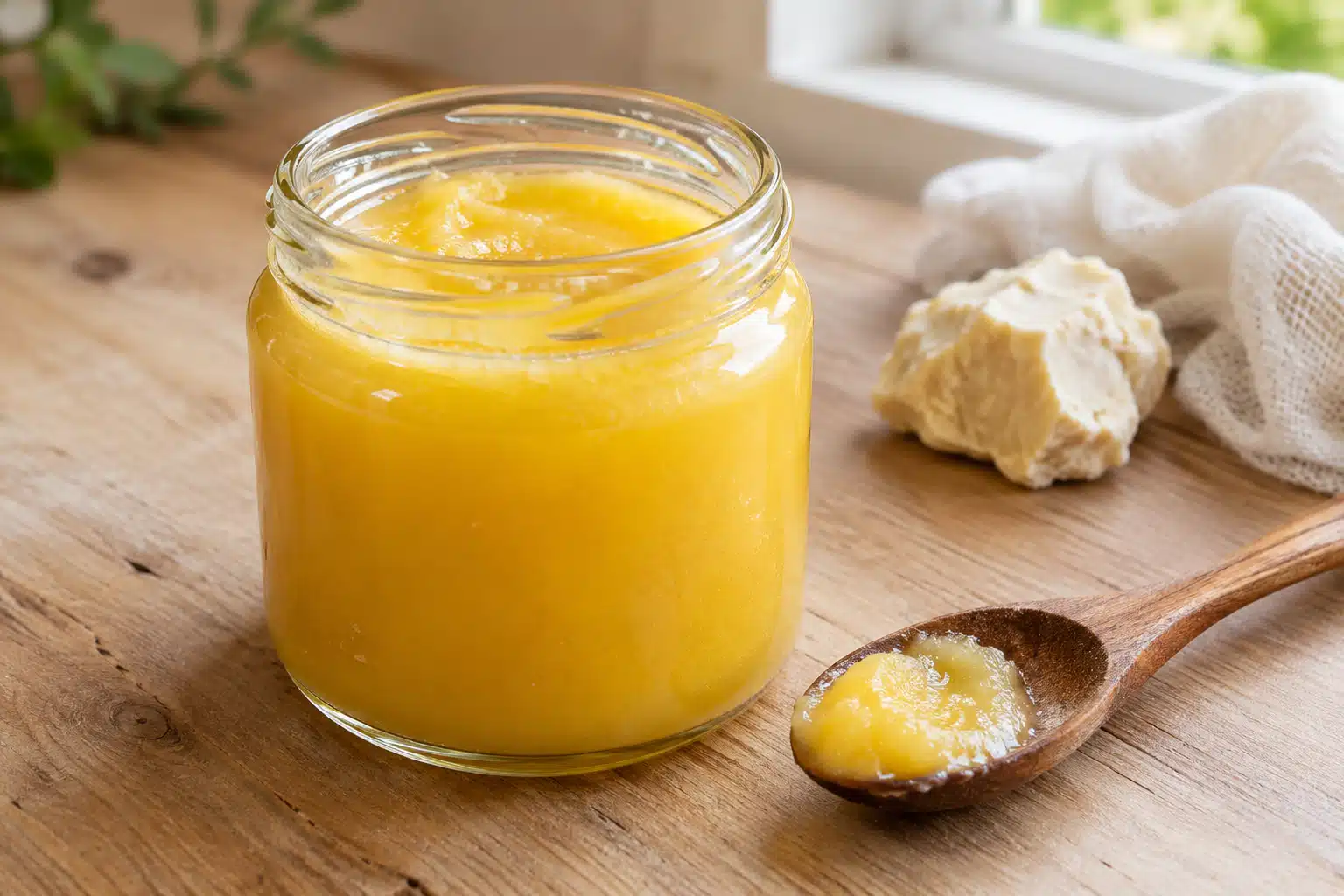
Ghee is a concentrated milk-fat product made by eliminating nearly all moisture and non-fat milk solids. It begins with butter, cream, or milk, which is heated gently until the water evaporates completely. As the milk solids separate and settle to the bottom of the pan, they are filtered out, leaving behind pure, clarified liquid fat.
Is ghee just another name for clarified butter? Not quite. Traditional clarified butter is simply heated until the water evaporates and the milk solids separate enough to be skimmed off. Ghee, however, is simmered a bit longer, allowing the milk solids at the bottom of the pan to lightly brown and caramelize. As the McGill Office for Science and Society notes, this gentle browning is precisely what gives ghee its signature nutty aroma and deep golden hue.
How to Make Ghee at Home in 5 Steps
Making a fresh batch of ghee takes about 30 minutes and requires just one ingredient: unsalted butter.
- Cut the butter into uniform chunks and melt them slowly over low heat in a heavy-bottomed saucepan.
- Bring the melted butter to a gentle simmer. As a white foam rises to the surface, skim it off with a spoon.
- Keep simmering until the liquid turns a clear, translucent gold and the bottom of the pan is visible. Watch the milk solids settling at the bottom—allow them to turn a light golden brown, but pull the pan from the heat before they burn.
- Let the liquid cool slightly in the pan.
- Pour the warm ghee through a fine-mesh sieve lined with cheesecloth into a clean, completely dry glass jar.
That last detail—a completely dry jar—is essential. Water, light, oxygen, and reactive metals all accelerate lipid oxidation, turning fats rancid before their time. Avoid storing ghee in iron or copper containers; stick with clean glass or ceramic instead.
What Is in Ghee?
Ghee features a complex fatty acid profile that directly dictates its melting behavior and skin feel:
- Fatty acid profile: Ghee consists of roughly 62% saturated fatty acids, 29% monounsaturated fatty acids, and 4% polyunsaturated fatty acids. In dairy fat, oleic acid typically accounts for 18% to 27% of the total profile, while butyric acid makes up about 3% to 5%.
- Vitamins: Ghee contains measurable amounts of vitamins A and E. Standard specifications for anhydrous milk fat cite roughly 1.0 mg of vitamin A and 3.8 mg of vitamin E per 100 grams. Vitamin D is practically negligible (under 0.2 micrograms per 100 grams), and vitamin K appears only in trace amounts. The frequent marketing claim that ghee is “packed with vitamins A, D, E, and K” is therefore overstated.
- Melting behavior: Because it is a natural blend of varied triglycerides, ghee does not have a single, sharp melting point. Technical literature notes a broad melting range between 28 °C and 44 °C (82–111 °F). For cow’s milk ghee, melting typically occurs between 33 °C and 36 °C (91–97 °F). Because this sits right at skin temperature, ghee softens instantly upon contact and glides on smoothly.
Cooking and Baking with Ghee
Thanks to its exceptionally high smoke point, ghee shines in culinary applications that would scorch ordinary butter—such as searing steaks, roasting root vegetables, or crisping potatoes. In regular butter, residual moisture and delicate milk proteins begin to burn between 140 °C and 180 °C (284–356 °F). Because those solids are removed from ghee, it handles intense heat with ease.
Store your ghee in an airtight jar kept in a cool, dark pantry; there is generally no need to refrigerate it. Homemade batches keep well for several weeks to a few months, while factory-sealed jars can last anywhere from 6 to 12 months. Always give the jar a quick sniff before using it. If it smells sour, unpleasantly pungent, or reminiscent of old crayons, the lipids have oxidized—discard it rather than using it in food or personal care products.
Ghee in Skincare: What Does the Science Say?
Ayurvedic medicine has used ghee topically for centuries, but modern dermatological research is still catching up. A 2024 literature review on ghee in Ayurvedic applications noted that studies evaluating its wound-healing and barrier-repair properties remain limited in both scope and methodological rigor. Most existing research relies on animal models, in vitro assays, or multi-herb Ayurvedic formulations where ghee serves merely as a carrier vehicle. These findings cannot be applied directly to pure ghee on human skin.
Two prevalent internet claims warrant a closer look:
- “Penetrates deep into the dermis.” There are no robust clinical delivery studies demonstrating that ghee travels deeper into skin layers than other conventional emollient fats.
- “Non-comedogenic.” There is no standardized, clinically verified comedogenicity rating for ghee. It is an intensely rich, 100% lipid substance. While various blogs label it anywhere from a 2 to a 4 on informal comedogenic scales, none cite peer-reviewed testing. If your skin is naturally oily or prone to breakouts, it is safest to keep ghee off your face.
Where ghee truly excels is as an occlusive, deeply conditioning lipid phase in body butters, restorative foot balms, and lip treatments. It acts as a classic barrier emollient: softening rough patches while sealing in hydration to keep skin supple.
Washed Ghee
Ayurvedic tradition also features a unique preparation called Shata Dhauta Ghrita, or “100-times washed ghee.” In this labor-intensive process, ghee is repeatedly whipped with cold water up to a hundred times. The result is a cooling, fluffy, snow-white emulsion that feels remarkably lightweight. While fascinating, it is a demanding undertaking. For most DIY formulators, standard ghee is far easier to work with.
Formulating with Ghee in DIY Recipes
How much ghee to include depends entirely on the product you are formulating:
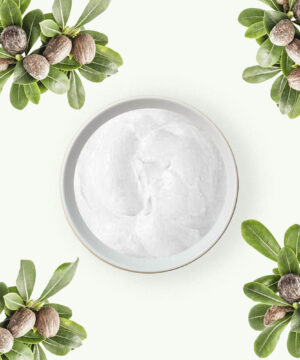
- Body butter: Incorporate between 20% and 50% ghee into your overall formula. To ensure the finished butter holds its shape at room temperature, balance it with a firmer butter. Refined shea butter works wonderfully here, as it provides solid structure without interfering with your scent blend. For detailed guidance on getting the balance right, consult our guide on making body butter.
- Lip balm: Use between 30% and 60% ghee, paired with a resilient natural wax to give the balm structural integrity. You will find a complete, tested formulation in our lip balm recipe.
- Cold process soap: A modest inclusion rate of around 10% of your total oil weight is a great starting point. Soapmakers often combine 10% ghee with coconut oil for robust lather and olive oil for gentle conditioning. Always calculate your lye amounts using ghee’s specific saponification value; you can review the process in our guide to calculating lye water.
- Hair care: Melt a pea-sized dab between your palms and smooth it sparingly through dry mid-lengths and ends, staying well clear of the scalp. Leave it on as a pre-shampoo treatment, then wash thoroughly. While scientific data on hair conditioning is scarce, it remains a beloved traditional remedy for parched ends.
Here is a straightforward baseline recipe for a 200-gram batch of whipped body butter:
- 30% ghee (60 g)
- 40% shea butter (80 g)
- 30% liquid carrier oil (60 g)
Consider this a starting framework. We recommend whipping up a small 50-gram test batch first to evaluate the texture, absorption, and firmness before committing to larger quantities.
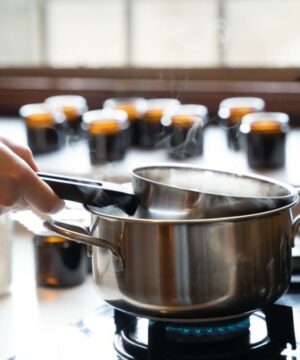
When melting your fats, use gentle indirect heat via a water bath to avoid burning the oils. A dedicated stainless steel double boiler insert makes temperature control effortless.
-

-
€6.87 €247.66Price range: €7.49€6.87 through €269.95€247.66 incl. VAT inc. VATExcl. VATSelect options This product has multiple variants. The options may be chosen on the product page


Troubleshooting Common Issues
Nutty aroma. A warm, toasted scent can be a welcome addition to a lip balm, but it may feel out of place in a crisp floral body cream. You can soften or mask the base scent by blending in a complementary fragrance oil.
Grainy texture. Graininess happens when the different fatty acids in your butter mixture cool and re-solidify at varying rates. To prevent gritty crystal formation, transfer freshly poured balms or body butters straight to the refrigerator so they set quickly and uniformly.
A heavy, greasy finish. If your formula feels overly greasy on the skin, whisk in a small pinch of starch. Fine starches cut surface shine and leave a smooth, velvety finish. Our organic cornstarch is ideal for balancing rich anhydrous formulas.
Rancidity over time. Because water-free lipid balms do not support microbial growth, they do not require an antibacterial preservative the way water-based lotions do. However, they are still vulnerable to oxidation. Keep finished products in airtight containers away from heat and sunlight, and always date your batches. Remember: if you introduce water to create an emulsion (like a cream or lotion), a broad-spectrum preservative is non-negotiable.
Who Should Avoid Ghee?
Because ghee is a dairy product derived from cow’s milk, individuals with a diagnosed cow’s milk allergy should avoid it entirely, as noted in clinical guidelines from allergy organizations like ASCIA and FARE. For those with lactose intolerance, ghee is generally well tolerated, as the clarification process leaves behind only trace levels of lactose (typically between 0.05 and 2.9 mg per 100 grams). However, while it is virtually lactose-free in practice, it is not certified as such. Comprehensive clinical data on topical dairy contact allergies is limited, so if you have reactive skin or known dairy sensitivities, always conduct a patch test on your inner arm before widespread use.
If you are looking for 100% plant-derived alternatives—or need lighter ingredients that will not overwhelm congestion-prone skin—consider formulating with shea butter, kokum butter, or cupuacu butter. If, on the other hand, you are eager to explore traditional animal-derived skincare, take a closer look at our guide to tallow in skincare.
Explore our full range of cosmetic oils and butters to find the ideal ingredients for your next recipe. Set up your digital scale, keep detailed formulation notes, and start experimenting!


