
You just poured the perfect candle. The scent is divine, the glass looks sleek and the wax has dried nice and smooth. But before you light, sell or gift this creation, you need to know one crucial thing: Is it safe? A candle is essentially an open fire in the living room. Without proper testing, that cozy little flame quickly turns into a dangerous situation, such as bursting glass or a stinging flame. Performing a proper fire test is not only wise, it is actually a requirement for anyone marketing candles. In this article, you’ll learn exactly how to test, what rules to follow and how to interpret the results.
Why testing is not optional
As a maker, you are responsible for the safety of your product. Whether you are a hobbyist making for friends or a small business owner; the rules apply to anyone who puts a product on the market. Candles must comply with the General Product Safety Regulation (GPSR), which simply means that you must be able to demonstrate that your candle is safe under normal use. In addition, testing is the only way to know if your wick-wax-scent combination works. A candle wick that burns perfectly in pure wax can completely drown as soon as you add fragrance oil.
Key safety standards
In Europe, specific EN standards have been established for candles. You may not need to set up a professional laboratory as a small maker, but you need to know these guidelines. NBN EN 15493 specifies requirements for fire safety. These include stability, where the candle must not fall over on a 10-degree incline, and the risk of secondary ignition. NBN EN 15494 deals with labeling and specifies which safety pictograms and warnings are mandatory on your label.
There are also chemical restrictions. For example, the lead content in the wick cannot exceed 100 ppm, and substances such as toluene and benzene are strictly limited. Fortunately, most raw materials have already been produced at specialized suppliers to meet these basic requirements. Your job is mainly to test how they react together in your specific recipe.
Step-by-step: conducting your own fire test
A fire test is more than lighting the candle and seeing if it does. You are simulating consumer behavior, but in a controlled manner. Be sure to keep a logbook in which you take notes for each round of testing. Start with a fully cured candle. For soy wax, this often means waiting at least one to two weeks. If you test too early, you will get unreliable results. Always cut the wick to about five millimeters before you start, exactly as you expect the end user to do.


Light the candle and let it burn in sessions of up to four hours. This is the standard cycle often used as a guideline. In the first hour, check that the flame burns quietly. If it flickers wildly, the wick may be too long or in a draft. In hours two and three, watch the melt pool. Ideally, the melted wax will reach the edge of the glass after about three to four hours. Blow out the candle after four hours. Feel or measure the temperature of the glass. It should not get so hot that you cannot touch it.
Pay close attention to soot formation during and after burning. Black smoke or soot on the edge of the glass indicates incomplete combustion. A flame should also not get too high; for container candles, you prefer a compact flame of two to three inches. If a thick rim of wax remains on the side, this is called tunneling. If a carbon globule develops on the wick, then you have mushrooming, which can lead to falling particles in the wax.
-
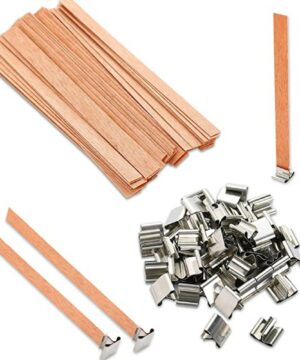
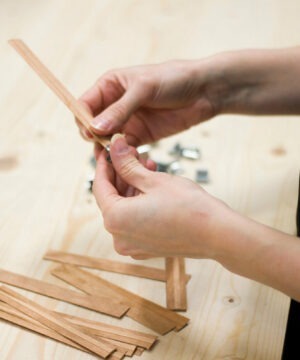 €2.44 €144.59Price range: €2.95€2.44 through €174.95€144.59 incl. VAT inc. VATExcl. VATSelect options This product has multiple variants. The options may be chosen on the product page
 -
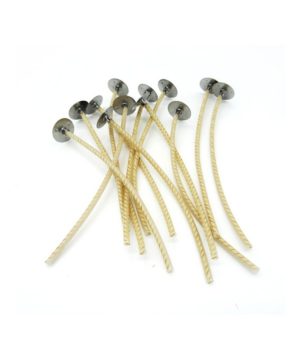 €1.61 €74.34Price range: €1.95€1.61 through €89.95€74.34 incl. VAT inc. VATExcl. VATSelect options This product has multiple variants. The options may be chosen on the product page


Troubleshooting and interpreting results
Finding the right combination is often a matter of trial and error. It is rare that your first test will be perfect. If you find that your candle is tunneling and burning only in the middle, the wick does not have enough power to melt the wax to the edge. You then need a size larger or a different type of wick. Read more about choosing the right wick for your project here.
Instead, do you suffer from a large, smoking flame or does the glass get dangerously hot? Then your wick is too large (“over-wicked”). This is more dangerous than tunneling because the glass can crack due to the heat. Using safe glass containers that can withstand heat is essential here, but does not solve the basic problem of an oversized wick.
-
 €1.53 €1,115.70Price range: €1.85€1.53 through €1,350.00€1,115.70 incl. VAT inc. VATExcl. VATSelect options This product has multiple variants. The options may be chosen on the product page
 -
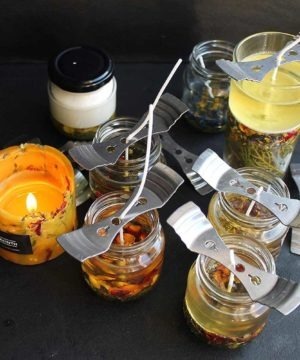
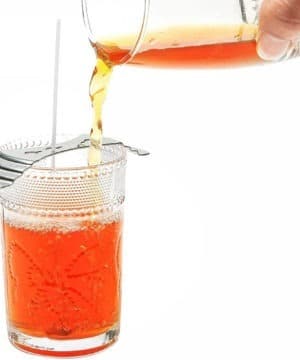


The choice of wax also plays a role. Soy wax, such as Golden Wax 464, behaves differently than kerosene. Sometimes it helps to switch candle waxes if you don’t achieve the desired results with wicks.
-
€4.92 €2,727.27Price range: €5.95€4.92 through €3,300.00€2,727.27 incl. VAT inc. VATExcl. VATSelect options This product has multiple variants. The options may be chosen on the product page


Labeling and documentation: CLP and UFI
In addition to the physical fire test, your paperwork must be in order. If you add fragrance oil, you fall under CLP (Classification, Labeling and Packaging) legislation. According to EU rules, your label must contain clear product identification so people know what’s in it. Hazard pictograms must be at least one square centimeter in size and accompanied by signal words such as “Warning” or “Danger.” Starting in 2025, a UFI code will be mandatory for many mixtures to help emergency services in case of poisoning. Learn more in our article on when a UFI code is required.
Also don’t forget the general safety pictograms from the EN 15494 standard, such as the plate warning never to leave candles unattended. If you’re going to make candles for sale, it’s smart to create a professional CLP label. The necessary data (SDS/MSDS) is available for our fragrance oils, so you know exactly which allergens to list.

Document everything
Keep the results of your fire tests carefully. Should a complaint ever arise, you can use your technical file to prove that you acted carefully. This file contains your recipe, the batch numbers of raw materials used, your test reports and a copy of the label. Do you really want to be sure, or are you going to produce large? Then you can also consider professional laboratory testing.
Safety may sound like a lot of hassle, but it is the foundation of a good product. Only when you know your candle is burning safely can you really enjoy the creative process. Start small, test thoroughly and build a brand that people can trust.


