
Making liquid soap sounds deceptively simple: combine soap with water, and you’re good to go. In reality, the method you choose makes all the difference—it determines whether you wrap up in fifteen minutes or spend half an afternoon carefully managing lye. For beginners, the easiest route is working with a ready-made liquid soap base: dilute it with demineralized water, stir in your fragrance, and add a preservative whenever extra water is introduced. If you prefer to make authentic soap entirely from scratch, you will need potassium hydroxide (KOH) and a serious commitment to safety.
Here, we break down all four methods, complete with sample formulations and the most common pitfalls to avoid.
Which Method Is Right for You?
| Method | Difficulty | What You Need | Preservative Needed? |
|---|---|---|---|
| Pre-made base | Easy | Soap base, demineralized water, fragrance | Yes, unless using an un-diluted, pre-preserved base |
| Custom surfactant recipe | Intermediate | Decyl glucoside, betaine, glycerin, xanthan gum | Yes |
| Saponifying with KOH | Advanced | Plant oils, KOH, digital scale, protective gear | Highly recommended once diluted |
| Grated bar soap | Easy | Bar of soap, water | Yes, otherwise it will spoil rapidly |
A few general guidelines:
- Fast results and custom fragrance: Choose a pre-made base.
- Tailored lather and skin feel: Formulate your own surfactant blend.
- Traditional, scratch-made soap from pure oils: Use KOH.
- Repurposing leftover soap scraps: Rebatch a bar of soap (keeping shelf-life limitations in mind).
Making Liquid Soap from a Pre-Made Base
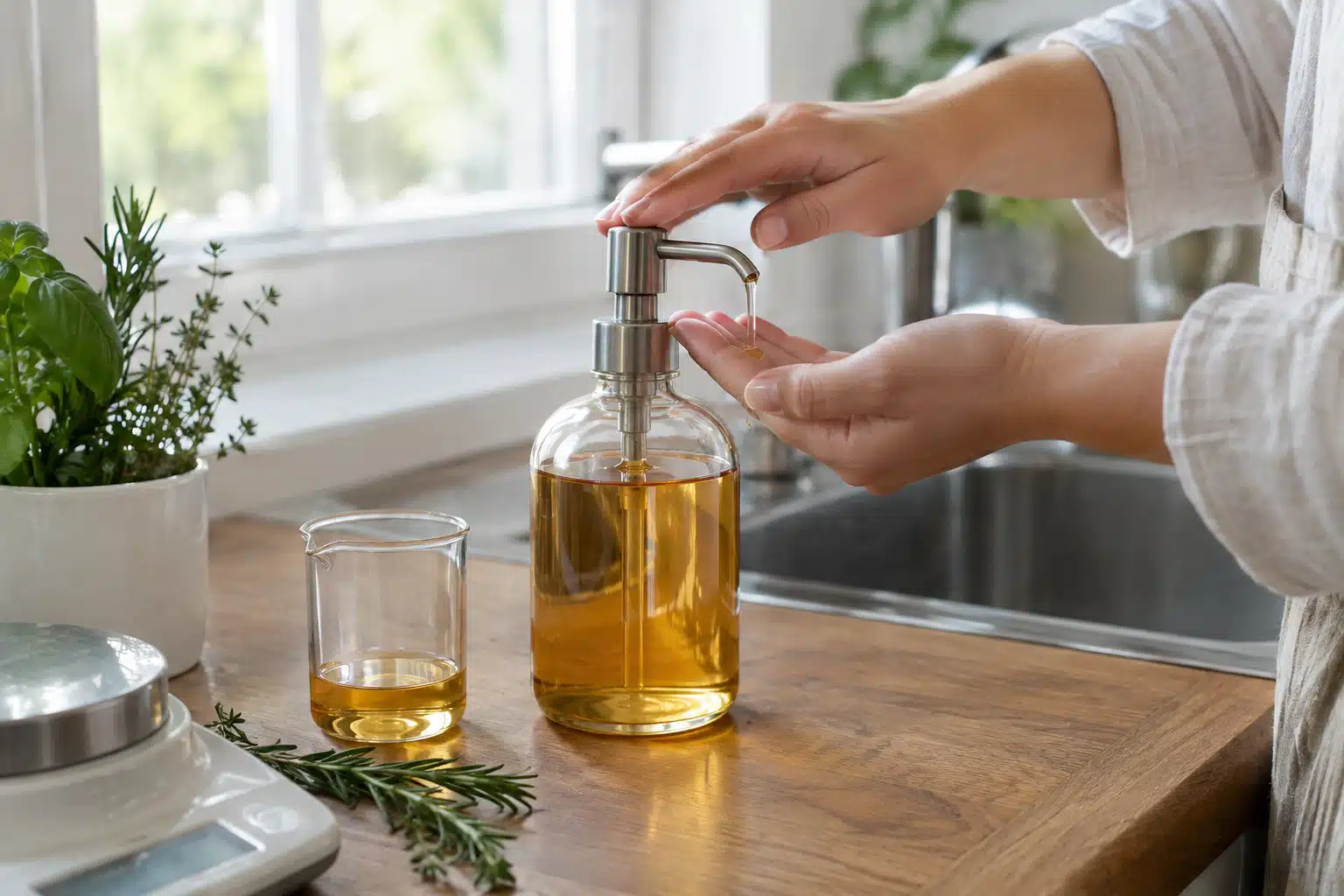
With a pre-made base, the manufacturer has already completed the saponification process. Your job is simply to dilute, scent, and color it. A popular option is YouWish liquid Castile soap, a concentrated base crafted from organic coconut and sunflower oils. You can explore the full range in our liquid soap base collection.
-
 €6.95 €3,305.79Price range: €6.95€6.95 through €4,000.00€3,305.79 incl. VAT inc. VATExcl. VATSelect options This product has multiple variants. The options may be chosen on the product page

Recommended dilution ratios vary widely by product. For instance, The Soap Kitchen advises a maximum ratio of 2 parts water to 1 part concentrate for its hand soap base. Meanwhile, a dense soap paste—such as Bramble Berry’s—can call for up to 4 parts water to 1 part paste. Always refer to the technical data sheet for your specific product. If no ratio is provided, start conservatively with less water and test the viscosity as you go.
Here is a sample calculation for a 500 g batch of hand soap using a base with a maximum 2:1 dilution ratio:
- Weigh out 167 g of base (one-third of your 500 g target).
- Add 333 g of demineralized water. Avoid tap water, as dissolved minerals and limescale can leave the finished soap cloudy.
- Stir gently. Do not whip the mixture, or you will create unnecessary foam.
- Add your fragrance: 1% of 500 g is 5 g.
- Thicken with a salt solution if needed (detailed below), then transfer the finished soap into a pump bottle.
Dosing Fragrance and Color
Fragrance usage rates depend on both the base and the specific aromatic profile. For pre-thickened options like 3-in-1 body wash, keep fragrance oil to a maximum of 1%; manufacturers warn that exceeding this threshold can thin out the formula and compromise clarity. On many of our product pages, the recommended usage rate for liquid soap falls between 1% and 3%. Always check the guidelines for your chosen scent and start on the conservative side. Browse the full range in our fragrance oil collection.
When tinting your soap, stick to water-soluble dyes. Most manufacturers recommend 2 to 6 drops per pound (454 g) for a balanced shade. Start with just a drop or two, blending thoroughly before deciding if you need more depth.
Thickening with Salt (and When It Fails)
If your diluted soap turns out too runny, you can often thicken it with a ~25% salt solution (brine), prepared by dissolving 0.5 parts non-iodized salt in 1.5 parts warm distilled water. Add this brine to your soap in tiny increments, stirring gently after each addition. The Soap Kitchen recommends a general limit of 4% salt solution (calculated against the weight of the undiluted base). Other suppliers suggest adding the brine strictly drop by drop, noting that too much salt will break the emulsion and thin the soap back out.
Be aware that not all bases respond to salt. Certain certified formulas, such as Liquid Soap 101, cannot be thickened with brine. In these cases, use cellulose gum or guar gum instead. Xanthan gum is another reliable thickener, though adding too much or failing to disperse it properly can leave the soap cloudy or gummy.
Formulating Your Own Hand Soap with Mild Surfactants
While pre-made bases are convenient, building a formula from scratch gives you complete authority over foam quality, cleansing power, and post-wash skin feel. Here is our master recipe for roughly 500 ml of hydrating liquid hand soap:
- 300 ml demineralized water
- 75 ml decyl glucoside (a gentle, non-ionic surfactant)
- 50 ml cocamidopropyl betaine (for richer, longer-lasting lather)
- 25 ml vegetable glycerin
- 5 g xanthan gum (to build gel viscosity)
- 5 ml Optiphen (a broad-spectrum preservative)
- 10 to 15 drops essential oil
-
 €3.95 €389.95Price range: €3.95€3.95 through €389.95€389.95 incl. VAT inc. VATExcl. VATSelect options This product has multiple variants. The options may be chosen on the product page
-
 €3.95 €389.95Price range: €3.95€3.95 through €389.95€389.95 incl. VAT inc. VATExcl. VATSelect options This product has multiple variants. The options may be chosen on the product page
-
 €4.95 €189.95Price range: €4.95€4.95 through €189.95€189.95 incl. VAT inc. VATExcl. VATSelect options This product has multiple variants. The options may be chosen on the product page

The order of addition is essential here. Start by creating a smooth slurry with the glycerin and xanthan gum; this prevents the gum from forming stubborn clumps. Pour the water into a larger vessel, stir in the gum slurry, and let it rest for several minutes to hydrate completely. Next, fold in the decyl glucoside and cocamidopropyl betaine using slow, steady strokes to avoid whipping up foam. Finally, blend in the preservative and essential oil. Let the formula settle for an hour before bottling it. For an in-depth walkthrough, read our guide on making your own liquid hand soap with a simple recipe.
A quick sanity check on the numbers: 5 ml of Optiphen in a ~500 ml batch translates to a 1% concentration. The manufacturer advises an addition rate between 0.3% and 1% below 80 °C (176 °F), putting this formulation at the upper threshold of the safe, effective range.
To learn more about the active cleansers used in modern formulas, check out our guide on making liquid soap: from bases to custom recipes.
Making Liquid Soap from Scratch with Potassium Hydroxide (KOH)
This traditional method is for makers who want genuine soap saponified directly from botanical oils, such as authentic olive oil Castile. While solid bar soaps rely on sodium hydroxide (NaOH), liquid soap requires potassium hydroxide (KOH), which yields soaps that dissolve cleanly in water. Because KOH has a higher molecular weight, it takes roughly 1.4 times more KOH than NaOH to saponify the same amount of oil. For that reason, you cannot simply substitute lyes in a bar soap recipe.
Safety First
KOH is strongly caustic and carries the hazard classification H314: causes severe skin burns and eye damage. Always wear chemical-resistant gloves (certified to EN 374), wrap-around safety goggles or a face shield, and long sleeves. Work exclusively in a well-ventilated space. When preparing your lye solution, always add the KOH flakes to the water slowly—never pour water onto dry lye. The product documentation for our cosmetic grade potassium hydroxide details these precise handling measures. If lye touches your skin, follow the ILO safety protocols: rinse under continuous running water for at least 15 minutes and seek medical evaluation immediately.
-
€12.95 €49.95Price range: €12.95€12.95 through €49.95€49.95 incl. VAT inc. VATExcl. VATSelect options This product has multiple variants. The options may be chosen on the product page

Calculating Your KOH Needs
Every oil has a distinct saponification (SAP) value. For liquid soap, divide the KOH SAP value by 1,000, then multiply by the total weight of that oil. A critical catch: soap-making KOH is typically sold at ~90% purity. If your calculator assumes 100% purity, your batch will end up with an unintentional 10% superfat (excess unreacted oil), which turns liquid soap permanently cloudy. You must correct for this by dividing your calculated KOH requirement by 0.9 or by adjusting the purity setting in your soap calculator.
Here is an example using 500 g of olive oil: A standard reference chart lists the KOH SAP value for olive oil as 0.1895. That means 500 × 0.1895 = 94.8 g of 100% pure KOH, which translates to 105.3 g of KOH flakes at 90% purity. Reference charts can vary by 1% to 3%, which is entirely normal. Always use a reputable soap calculator with adjustable superfat and purity settings, and verify your numbers against a second source. For more details, explore our guide on calculating lye water.
From Soap Paste to Liquid Soap
- Dissolve your KOH in room-temperature water. A lye concentration between 25% and 35% is standard.
- Blend the lye solution into your warmed oils, then cook the batch in a slow cooker for several hours until it forms a fully saponified, translucent paste.
- Test a sample of the paste for clarity and neutrality, then dilute the batch with hot distilled water. Because dilution rates vary by formulation, add water gradually.
- Check the pH using test strips or a calibrated digital pH meter. If the soap is overly alkaline, neutralize it incrementally with a 20% citric acid solution (20 g citric acid dissolved in 80 g water), stirring thoroughly and retesting after every few drops.
- Blend in your fragrance oil and package the finished soap in clean pump bottles.
Understanding pH and Your Skin
Do not expect true oil-based soap to be pH-neutral. Saponified soap is inherently alkaline, settling at a pH between 9 and 10, whereas the natural acid mantle of human skin sits between 4.5 and 5.5. A custom surfactant blend can easily be formulated closer to the skin’s natural range. Keep in mind, however, that a lower pH does not automatically mean a product is gentler; a 2021 study confirmed that surfactant selection plays just as substantial a role in skin tolerance as pH does. For more on formulating mild washes, read our feature on pH-neutral soap.
Making Liquid Soap from a Bar of Soap
Melting down bar soap is a handy, zero-waste way to repurpose odds and ends. Simply grate the bar finely, dissolve the shavings in hot (not boiling) water, and let the mixture cool. Proportions vary: common recipes call for anywhere from half a cup of shredded soap per three cups of water to an entire bar per eight cups. More water creates a lighter, runnier soap, while a dash of vegetable glycerin helps restore a silky texture.
The major drawback here is shelf life. Introducing water creates an ideal environment for microbial contamination. While some makers assume the alkaline pH of true soap will prevent spoilage, unpreserved batches frequently turn sour or develop mold within a few weeks—even in the refrigerator. We recommend making only what you can use immediately, or adding a broad-spectrum preservative. For safe handling advice, read our guide on soap storage and shelf life.
To see how traditional cold-process bars compare to modern body washes, take a look at our comparison guide: liquid soap vs. bar soap.
Preservatives: When Are They Necessary?
The golden rule of cosmetic formulation is straightforward: if it contains water, it requires a preservative. Liquid soaps and body washes carry high water activity, making them prime targets for bacteria, yeast, and mold. Preservatives are not optional add-ons; they are essential for product safety. The only real exception is undiluted, pure KOH soap paste, which is self-preserving due to its minimal free water and high pH. The moment you dilute that paste, you must protect it. Commercial bases, like our 3-in-1 body wash, arrive pre-thickened and pre-preserved; for any other base, follow the supplier’s preservation protocol.
Two best practices to keep in mind:
- Temperature control: Always let your liquid soap cool down before adding your preservative system. Most preservatives degrade above 40 °C (104 °F), though Optiphen can tolerate up to 80 °C (176 °F).
- Weigh, don’t guess: Dose preservatives strictly by weight based on the total batch size, never by counting drops or eyeballing volume.
You can find proven preservatives like Cosgard in our liquid soap base catalog, alongside popular options like sodium benzoate.
To see how humectants boost the performance of your recipes, read about the benefits of glycerin in soap and skincare.
Selling Your Homemade Soap
The moment you plan to sell your soap, you enter a tightly regulated market. Within the EU, cosmetic products—including handmade soaps—are governed by EU Regulation (EC) No 1223/2009 and overseen locally in the Netherlands by the NVWA. Before you can offer a single bottle for sale, you must commission a Cosmetic Product Safety Report (CPSR), designate an EU-based Responsible Person, and submit your formulation through the European Cosmetic Products Notification Portal (CPNP). Your packaging must feature full INCI ingredient declarations along with the Responsible Person’s contact information. These legal obligations apply equally to liquid washes, body washes, and solid bars, regardless of the preservatives or natural claims involved.
Where Should You Start?
If you are new to the craft, begin with a 500 g batch of pre-made base. Weigh your ingredients accurately, stick to demineralized water, and keep notes on your dilution ratios so you can replicate your favorites. Once you have a feel for dilution and viscosity, you can move on to custom surfactant formulas, and eventually take on scratch-made saponification with KOH. Ready to begin? Browse our curated liquid soap and shampoo section to choose your base.


