
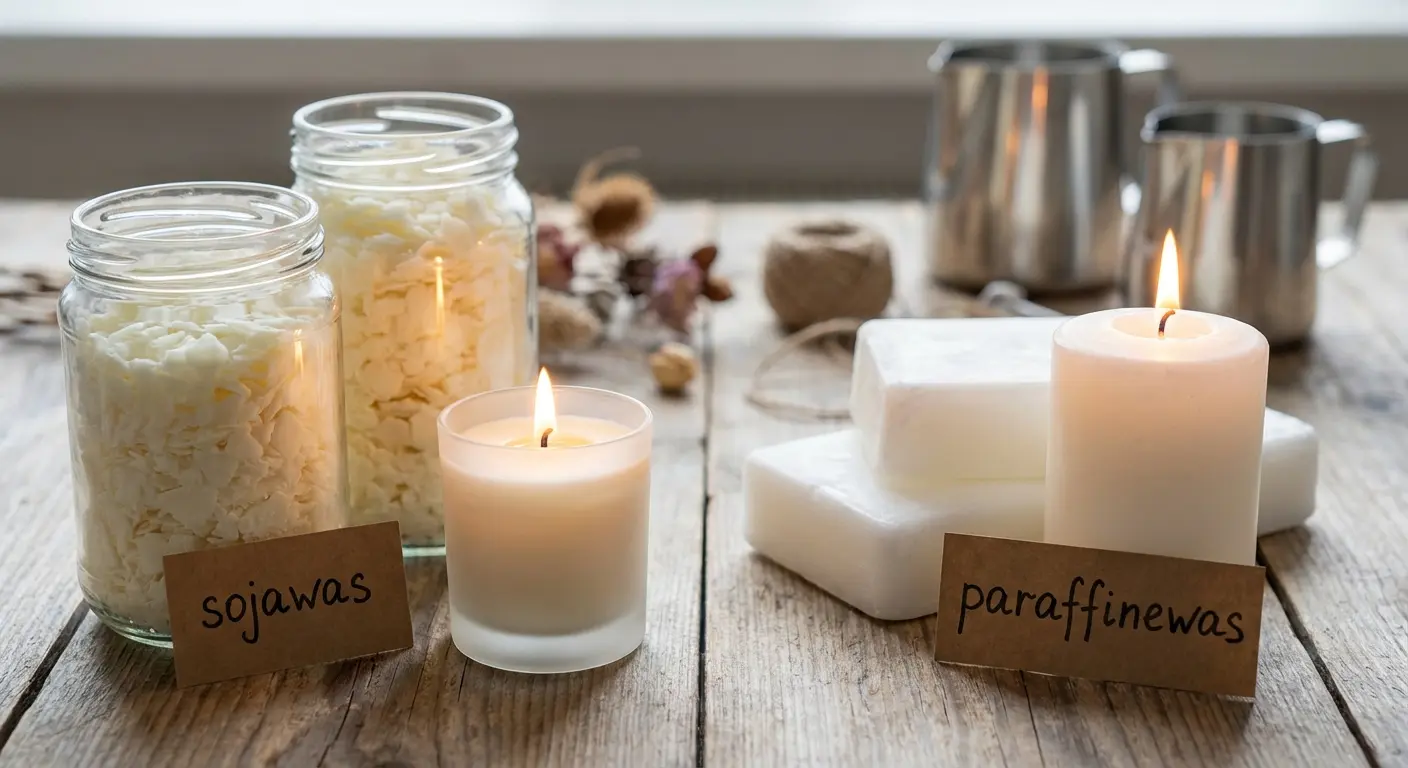
Staring at your shopping cart and wondering which wax to choose for your next pour? You are not alone. Soy wax and paraffin wax are the undisputed heavyweights of the candle-making world. Each behaves differently in the pot, requires its own pouring temperatures, and yields a distinct finished look. To help you choose the right base for your candles, we break down how they compare across sustainability, burn quality, safety, and overall cost.
Health and Burn Emissions
Paraffin wax often stirs up heated debate among candle makers. Because paraffin is a byproduct of crude oil refining, there is a common misconception that burning it fills your living room with harmful toxins. In reality, scientific studies show that unscented, properly formulated paraffin and soy waxes produce nearly identical emissions under normal burning conditions.
Soot is rarely an issue with the wax itself; rather, it usually points to an improperly chosen or maintained wick. A wick that is oversized or left untrimmed burns too hot, leading to incomplete combustion and visible black soot regardless of your wax base. Choosing the correct wick size for your container’s diameter is crucial for a clean burn. For step-by-step guidance on pairing your materials, check out our guide on how to choose the right wick.
Sustainability and Raw Materials
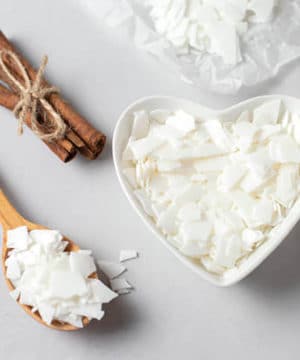
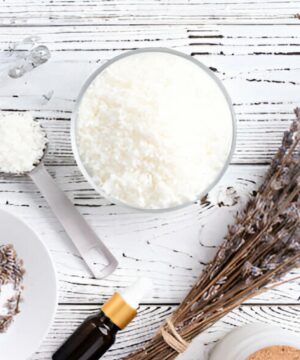
If your brand values renewable, plant-based ingredients, soy wax is the clear winner. Created through the hydrogenation of soybean oil, it is both biodegradable and 100% vegan-friendly.
Paraffin wax, by contrast, is derived from petroleum during the oil refining process, making it a non-renewable resource. While many eco-conscious makers gravitate toward natural soy wax, others rely on traditional paraffin wax for its unmatched consistency, stability, and ease of use.
-
 €4.92 €135.00Price range: €5.95€4.92 through €135.00€135.00 incl. VAT inc. VATExcl. VATSelect options This product has multiple variants. The options may be chosen on the product page
 -
€3.95 €103.31Price range: €3.95€3.95 through €125.00€103.31 incl. VAT inc. VATExcl. VATSelect options This product has multiple variants. The options may be chosen on the product page


Burn Quality, Scent Throw, and Curing
How these two waxes perform in the finished candle reveals some of their biggest differences:
- Scent throw: Paraffin is renowned for its impressive cold throw (unlit) and hot throw (lit). Its crystalline structure allows fragrance oils to disperse quickly and effortlessly into the air. Soy wax delivers a more subtle, delicate aroma that requires patience; it typically benefits from a one- to two-week cure time for the scent to bind properly.
- Burn time: Soy wax has a lower melting point, which allows it to burn cooler and significantly slower than paraffin. All else being equal, a soy candle will give you more burn hours per ounce.
- Appearance and finish: Paraffin naturally dries with a smooth, glossy finish. Soy wax tends to dry with a matte, textured surface and is prone to “frosting”—a white, crystalline bloom that develops on the tops and sides. While frosting is entirely cosmetic and has zero impact on burn performance, it can catch beginners off guard. Read our guide on how to fix candle frosting for troubleshooting tips.
To learn more about how different waxes behave, explore our beginner’s guide to candle wax.
Price and Workability Differences
When it comes to your bottom line, paraffin wax is generally more affordable than soy. It is an economical, forgiving base that takes dye exceptionally well, yielding rich, vibrant colors with minimal effort.
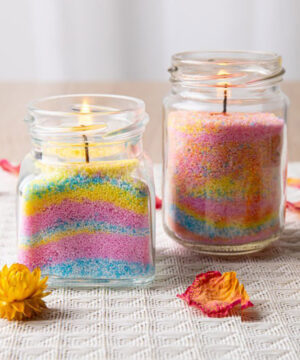
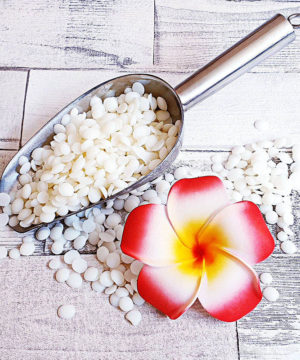
Soy wax demands a bit more precision. It is best melted in a double boiler and poured within a specific temperature window—typically between 55°C and 65°C—to prevent sinkholes and rough tops. If you want to skip the melting pot altogether, granular paraffin-based candle sand is another fun, mess-free option worth exploring.
-
 €4.95 €495.87Price range: €4.95€4.95 through €600.00€495.87 incl. VAT inc. VATExcl. VATSelect options This product has multiple variants. The options may be chosen on the product page
 -
 €4.95 €165.25Price range: €4.95€4.95 through €199.95€165.25 incl. VAT inc. VATExcl. VATSelect options This product has multiple variants. The options may be chosen on the product page


Which Wax Is Right for Your Candle Project?
The best wax ultimately comes down to what you are crafting and the look you want to achieve:
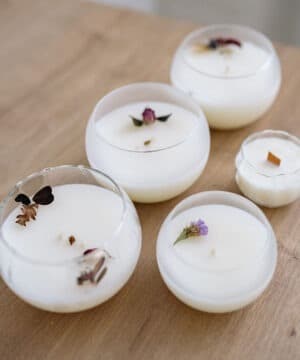
- Choose soy wax if you are pouring jar or container candles, marketing an eco-friendly or vegan product line, and want a long, gentle burn. Follow our comprehensive tutorial on making soy candles to get started.
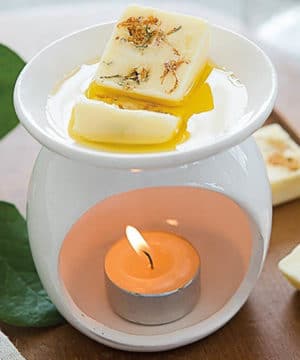
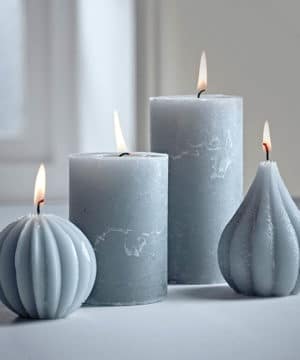
- Choose paraffin wax if you are making freestanding pillar candles, votives, or detailed wax melts, or if your top priorities are bold colors and room-filling scent throw. Discover which melt point suits your molds in our overview of types of paraffin wax.
- Choose a parasoy blend if you want the best of both worlds: the creamy, premium aesthetic of soy combined with the rigidity, vivid colors, and powerhouse scent throw of paraffin.
-
 €9.05 €155.95Price range: €10.95€9.05 through €155.95€155.95 incl. VAT inc. VATExcl. VATSelect options This product has multiple variants. The options may be chosen on the product page
 -
 €7.40 €148.72Price range: €8.95€7.40 through €179.95€148.72 incl. VAT inc. VATExcl. VATSelect options This product has multiple variants. The options may be chosen on the product page
 -
 €4.95 €123.93Price range: €4.95€4.95 through €149.95€123.93 incl. VAT inc. VATExcl. VATSelect options This product has multiple variants. The options may be chosen on the product page
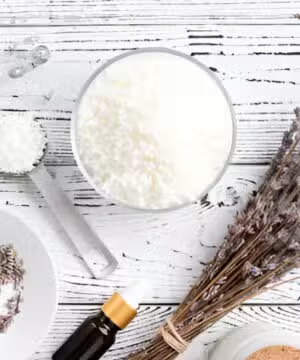


Hands-on testing is the best way to see which wax fits your workflow. Start with a small test batch using our guide on making candles with natural wax and fragrance oil. When you are ready to restock, explore our complete selection of candle wax and bring your next creation to life.


