
Cut into an authentic bar of Aleppo soap, and you will see two distinct shades: a warm, ochre-brown exterior giving way to a deep, olive-green core. That striking green hue comes entirely from laurel oil. However, the term “laurel oil” can be deceptive, and confusion around it has tripped up many soap makers. A thick, dark green oil pressed from the berries is an entirely different ingredient from the potent essential oil distilled from the leaves.
For soapmaking, what you need is laurel berry oil (INCI: Laurus Nobilis Fruit Oil). Traditional Aleppo soap is formulated with 5% to 40% laurel berry oil, with olive oil making up the rest of the recipe. For beginners, a concentration between 10% and 25% hits the sweet spot. Laurel leaf essential oil, on the other hand, is a completely different substance subject to strict cosmetic safety limits—it should never be used as a base oil in soap.
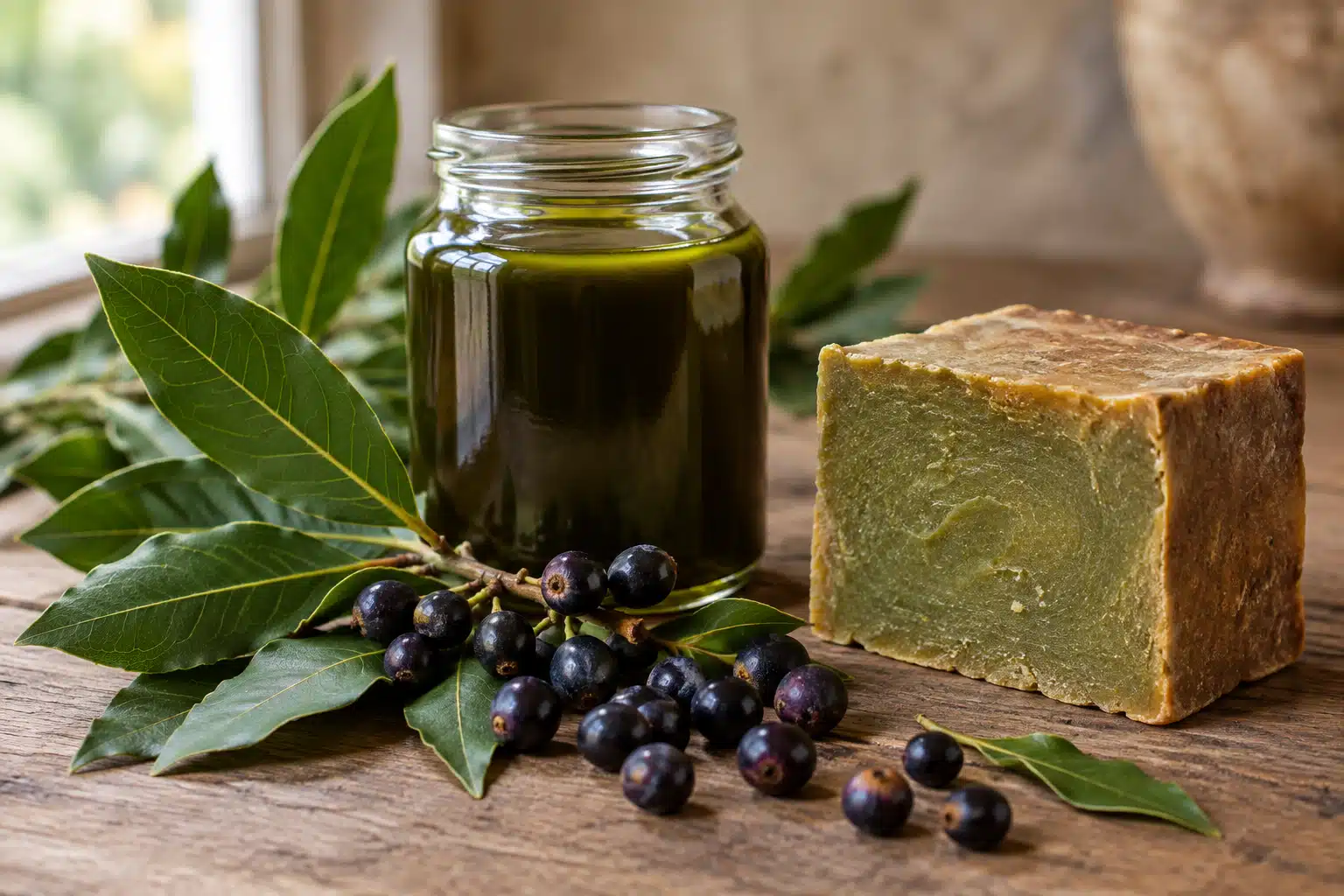
Laurel Berry Oil vs. Laurel Leaf Oil: What’s the Difference?
Both oils come from the bay laurel tree (Laurus nobilis), but their extraction methods, chemical profiles, and applications could not be more different.
| Laurel Berry Oil | Laurel Leaf Oil | |
|---|---|---|
| Plant Part | Fruit (berry) | Leaf |
| Oil Type | Fixed / carrier oil (cold-pressed) | Essential oil (steam-distilled) |
| Appearance | Viscous, deep olive to dark green; semi-solid below ~21 °C | Thin, watery liquid; clear to pale yellow |
| Role in a Recipe | Base oil, primarily in soap | Fragrance / active component, strictly diluted |
| INCI | Laurus Nobilis Fruit Oil | Laurus Nobilis Leaf Oil |
If a supplier simply labels a product “laurel oil,” always check the INCI name and inspect the physical oil. A thin, pale liquid is leaf essential oil. A viscous, dark green oil that semi-solidifies at cooler room temperatures is berry oil. If your laurel berry oil drops below 21 °C (70 °F), gently warm the bottle in a warm water bath before measuring.
How Laurel Berry Oil Behaves in Soap
The fatty acid profile of laurel berry oil can vary substantially from harvest to harvest. Studies show lauric acid content ranging anywhere from 8.6% to 54%, and oleic acid from 15% to 42%. This natural variance explains why batches sourced from different regions or suppliers can behave quite differently in the soap pot.
Here is what you can consistently expect:
- A pronounced herbal, earthy, and slightly medicinal aroma. While it mellows over a long cure, it never disappears entirely.
- A natural green tint in your finished bars, ranging from soft sage to deep moss depending on your usage rate.
- Variable trace times. Formulation reports vary widely: some soap makers find that laurel berry oil slows down trace, while others experience sudden acceleration. Always run a small test batch when working with a new lot.
Double-check your lye calculations. Saponification values for laurel berry oil can vary between reference charts. Soap Ledger lists a value of 0.143 g NaOH per gram of oil (SAP value: 200.25 mg KOH/g), while published Turkish research cites 0.140 g NaOH per gram. While that difference might seem minor, natural batch-to-batch variations do occur. Ask your supplier for a batch-specific Certificate of Analysis (CoA) or technical data sheet, and run your formulation through a lye calculator, as detailed in our guide to calculating lye solutions.
Choosing Your Laurel Oil Percentage
On a traditional bar of Aleppo soap, the stated percentage refers strictly to laurel berry oil as a proportion of total oil weight. A “30%” bar is made from 30% laurel berry oil and 70% olive oil—not 30% of the finished bar’s overall mass.
| Percentage | Soap Characteristics | Best Suited For |
|---|---|---|
| 5–12% | Mild, gentle, highly conditioning | Daily cleansing, dry or sensitive skin |
| 15–25% | Well-balanced lather with a classic Aleppo character | Normal to combination skin; the ideal starting point |
| 30–40% | Rich herbal scent, firmer lather, stronger cleansing | Oily skin, clarifying shampoo bars |
To make a 1,000 g oil batch at 20% laurel, you would measure out 200 g laurel berry oil and 800 g olive oil. A classic Aleppo recipe from soapformulator.com combines this ratio with 131.2 g NaOH and 266.4 g distilled water. Because precise lye and liquid amounts hinge on your chosen superfat and water discount, always customize these figures to your specific formulation.
While it is technically possible to push past 40%, laurel berry oil is significantly more expensive than olive oil, and its herbal aroma can easily overpower the senses.
Authentic Aleppo soap is kettle-cooked via hot process, with the laurel berry oil folded in toward the end of the cook to preserve its delicate components. The soap is then aged for six to nine months, during which the exterior oxidizes into its signature golden-brown shell while the interior stays vibrant green. If you make it using the cold process method, you are producing an Aleppo-style soap. It makes a phenomenal bar—just be transparent about your method if you sell your soap.


For a deeper dive into formulating these bars, see our guide on Aleppo soap and choosing the right laurel percentage. If you want to brush up on the fundamentals before you begin, the science behind cold process soap covers the essential chemistry.
Uses Beyond Cold Process Soap
Formulators also use laurel berry oil in solid shampoo bars, conditioning salves, and body butters, where its semi-solid melting point lends natural body and firmness to balms. In solid shampoo formulations, suppliers often suggest using it at 30% to 40% of the total oil phase.
Approach leave-on skincare with caution, however. Clear, authoritative dermal limits for leave-on products are scarce, and many suppliers advise against applying neat laurel berry oil directly to the skin. This caution is well-founded: between 1860 and 1960, felt production commonly utilized “laurel oil”—an unrefined blend of fixed oil and volatile compounds from the fruit. The Tisserand Institute notes that clinical patch tests from this era revealed allergic contact sensitization in over 4% of subjects. Always conduct a patch test, and never bring leave-on formulations to market without a formal safety assessment.
Safety and Regulatory Considerations
Laurel Leaf Essential Oil
Laurel leaf essential oil is regulated under Annex III of the EU Cosmetics Regulation (EC No 1223/2009). If its concentration exceeds 0.001% in leave-on products or 0.01% in rinse-off formulations, it must be declared on your ingredient label. Safety data sheets classify laurel leaf oil as a Category 1 Skin Sensitizer. In addition, the oil naturally contains methyleugenol, an established fragrance allergen restricted to strict maximum limits: 0.001% in rinse-off products and 0.0002% in leave-on formulas.
Is Laurel Oil Banned?
No, but the regulations hinge on precise botanical nomenclature. Annex II of the EU Cosmetics Regulation prohibits “Laurus nobilis seed oil” (CAS 84603-73-6). In contrast, cosmetic-grade laurel berry oil used in Aleppo soap is pressed from the whole fruit and sold under the INCI name Laurus Nobilis Fruit Oil (CAS 8007-48-5). Because enforcement interpretations can vary, anyone selling laurel-based soap should ensure their raw material documentation is airtight and that the ingredient is thoroughly vetted by their safety assessor. (YouWish also offers cosmetic product safety assessments / CPSRs).
Pregnancy
Comprehensive, evidence-based safety data regarding laurel oil during pregnancy is limited for both the pressed berry oil and the leaf essential oil. The UK Teratology Information Service (UKTIS) highlights the lack of robust epidemiological studies on essential oils during pregnancy. As a prudent measure, avoid laurel leaf essential oil while pregnant, and advise pregnant clients to consult their healthcare provider.
Storage and Shelf Life
Keep laurel berry oil stored in an airtight, opaque container in a cool, dark room. Depending on the processing method and supplier, shelf life ranges from 12 to 36 months. Industry technical sheets generally recommend retesting the oil’s acid and peroxide values if stored for longer than 24 months. Always inspect the clarity, color, and aroma of your stock before adding it to a fresh batch of soap.
Ready to Get Started?
Once your Aleppo formulation is finalized, browse our selection of oils and butters for high-grade olive oil and other soapmaking essentials. If you are just starting out, check out our beginner’s guide to soap making. We recommend mixing up a modest test batch at a 20% laurel berry oil ratio—give it several weeks to cure, and experience this ancient soap tradition for yourself.


