
That bottle of walnut oil in your pantry can easily double as a cosmetic ingredient in your workshop. But handle it with care: while it is delightfully lightweight and sinks into the skin with ease, it is also one of the most fragile carrier oils you can work with. Linoleic acid makes up well over half of its fatty acid profile, which explains its quick absorption—and why it turns rancid so rapidly when improperly stored.
The takeaway for formulators is straightforward: keep your inclusion rates modest, design products intended to be used within a few months, and protect the oil from light, heat, and air at every stage. Below, you’ll find the science behind its behavior alongside practical formulation benchmarks for your recipes.
Walnut Oil at a Glance
Keep these essential values handy when developing your formulas:
| Property | Value |
|---|---|
| INCI name | Juglans Regia Seed Oil |
| Linoleic acid (omega-6) | approx. 49% to 62% |
| Alpha-linolenic acid (omega-3) | approx. 8% to 14% |
| Oleic acid | approx. 14% to 26% |
| SAP value (NaOH) | 0.135 g per gram of oil |
| Skin feel | Lightweight, fast-absorbing, dry finish |
| Shelf life | 6 to 18 months (depending on grade and storage) |
| Allergen | Tree nut; cold-pressed varieties may contain residual proteins |
What Is in Walnut Oil?
Extracted from the kernels of the common English or Persian walnut (Juglans regia), walnut oil represents roughly 60% of the kernel’s total weight, according to technical datasheets from cosmetic suppliers.
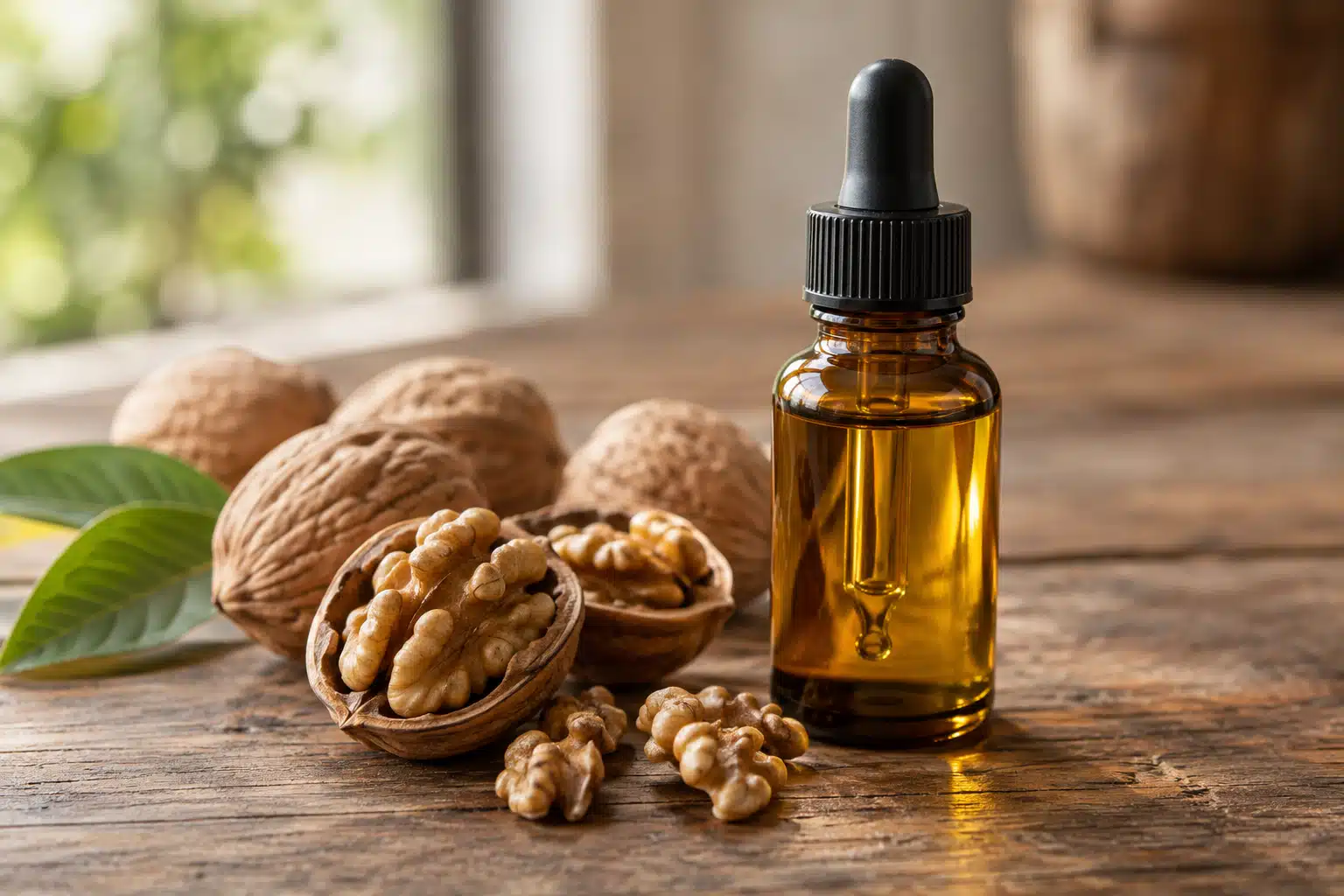
A typical fatty acid analysis of cold-pressed walnut oil shows approximately 59% linoleic acid, 16% oleic acid, 10% alpha-linolenic acid, and 6% palmitic acid. In total, saturated fatty acids make up a mere 9% of the composition.
Because fatty acid ratios shift based on walnut cultivar, growing region, and processing method, broad literature reviews report ranges of 49% to 62% for linoleic acid, 8% to 14% for alpha-linolenic acid, and 14% to 26% for oleic acid. Due to this natural variability, always request the batch-specific Certificate of Analysis (COA) or technical data sheet directly from your supplier.
What does this chemistry mean at the workbench? This dense concentration of polyunsaturated fatty acids gives walnut oil its signature satin, non-greasy skin feel. At the same time, those multiple double bonds leave it exceptionally vulnerable to oxidative breakdown. That single trade-off dictates how you must formulate with and store this oil.
Walnut oil also delivers natural vitamin E, predominantly as gamma-tocopherol. Studies report concentrations between 190 and 440 mg per kilogram of oil, depending on the cultivar and processing. While this native vitamin E offers some initial protection against oxidation, it will not prevent rancidity indefinitely once exposed to environmental stressors.
Cold-Pressed vs. Refined
You will generally encounter two grades on the market:
- Cold-pressed: Pale yellow to amber with a rich, characteristic nutty aroma. Best suited for formulations where you want the natural scent to shine through.
- Refined: Light in color and practically odorless. Ideal when you need a neutral lipid base that will not clash with delicate essential oils or fragrance blends.
Note that refining also alters the oil’s allergenic profile, as explored below.
What Does Walnut Oil Do for Skin and Hair?
Linoleic acid is an indispensable component of healthy skin barrier function. In a landmark clinical study on individuals with linoleic acid deficiency, applying 250 mg of sunflower oil daily to the forearm restored normal trans-epidermal water loss (TEWL) and significantly reduced scaling within two weeks (source: Linus Pauling Institute). Although that trial examined sunflower oil in a deficient population, it highlights why linoleic-dominant oils remain staples in formulations for dry, compromised skin.
Direct clinical data on walnut oil itself is more conservative. One review found that walnut oil in an oil-in-water emulsion significantly improved skin hydration, but broader therapeutic claims lack scientific backing. Keep this distinction in mind when crafting product copy to ensure your marketing claims remain compliant and grounded.
Makers often ask whether walnut oil will clog pores. In truth, there is no standardized, clinically validated comedogenic scale for cosmetic oils. The ratings from 0 to 3 found across the internet are largely anecdotal. If you are formulating for oily, acne-prone skin, run your own patch tests and start with conservative usage rates.
Regarding acne, one small clinical study involving 20 patients with mild acne found that applying a topical gel containing 2.5% pure linoleic acid reduced the size of microcomedones by approximately 25% over one month. However, that trial evaluated isolated linoleic acid in a gel vehicle, not whole walnut oil. View this as evidence of linoleic acid’s physiological function rather than proof that walnut oil treats breakouts.
Similarly, cosmetic oils in handcrafted skincare are not medical treatments for conditions like eczema or psoriasis. Anyone managing a chronic inflammatory skin condition should consult a dermatologist before introducing new topical products.
In hair care, raw material distributors often market walnut oil for dry, brittle strands and parched scalps. While this reflects supplier positioning rather than head-to-head clinical trials, its real-world benefit in a DIY hair serum is clear: it imparts conditioning slip and surface shine without weighing down the hair.
Comparing Walnut Oil to Other Oils
Here is how walnut oil compares to several common carriers in your workshop:
- Jojoba oil: Chemically speaking, jojoba is a liquid wax ester rather than a true triglyceride (roughly 98% wax esters), making it extraordinarily stable against heat and light. It offers a similarly light skin feel but boasts an vastly longer shelf life. Explore our in-depth guide on jojoba oil and its benefits.
- Sweet almond oil: A monounsaturated-rich carrier with a rounder, richer cushion on the skin. A 16-month stability study comparing cold-pressed nut oils found that sweet almond oil outlasts walnut oil by a wide margin under identical conditions.
- Andiroba oil: A rich, specialty rainforest oil with distinct functional properties, detailed in our guide on andiroba oil for skin, hair, and soap.
How do you choose? If you are formulating a product for retail distribution requiring a 12-month or longer shelf life, use jojoba or another oxidation-resistant oil as your primary base. If you are formulating a fresh, small-batch product for immediate personal use—such as an intensive scalp oil—walnut oil is a fantastic fast-absorbing choice. You can evaluate and compare more carriers across our range of cosmetic oils and butters.
Formulating with Walnut Oil
Recommended inclusion rates vary by product format. These industry guidelines serve as practical starting points for bench testing:
- Leave-on facial products: 1% to 8%
- Leave-on body and hair care: 3% to 20%
- Emulsions (lotions and creams): 2% to 10%
- Lip products: 2% to 10%
- Cold process soaps and rinse-off bars: 2% to 8% (up to 15% in specialty artisan recipes)
In Cold Process Soap
Walnut oil is classified as a soft conditioning oil. In standard soap calculators, a 100% walnut oil bar scores roughly 9 for hardness, 0 for cleansing, 78 for conditioning, and 0 for lather (scores vary slightly depending on the calculator). It is entirely unsuitable as a primary base oil, but it excels as a secondary luxury additive to boost conditioning.
While some soapmaking references cite inclusion rates up to 15%, walnut oil’s low oxidative stability creates a significant risk of dreaded orange spots (DOS) as the soap cures. We recommend keeping walnut oil between 5% and 8% of your total oil weight to maintain bar hardness and preserve long-term freshness.
For your lye calculations, walnut oil has a saponification value of 0.135 g NaOH per gram of oil (or 0.189 to 0.190 for KOH). Be careful with unit scales: 189–190 denotes milligrams of KOH per gram, which must not be entered directly into an NaOH calculator. For instance, in a 500-gram batch of oils using an 8% walnut oil inclusion (40 grams), that portion requires 5.4 grams of NaOH (40 × 0.135). With a 5% superfat discount, that portion requires 5.13 grams. Always run your complete recipe through a reliable soap calculator. To master the underlying math, read our tutorial on calculating your lye solution. If you are brand new to the craft, begin with our beginner’s guide to cold process soapmaking.
In Lotions, Balms, and Lip Products
Walnut oil functions best as a balancing emollient alongside dense vegetable butters. In a 200-gram lotion formula, a 5% inclusion equals 10 grams of oil. Whenever possible, incorporate walnut oil during the cooldown phase (below 40 °C / 104 °F) to preserve its delicate polyunsaturated fatty acids from prolonged heat. For recipe ideas with rich textures, check out our guide on making natural body butter at home or browse our lip balm recipes.
In Hair and Beard Oils
In anhydrous beard oils and hair serums, you can incorporate higher concentrations because the formula consists entirely of active lipids. Explore our beard oil recipes to see how light and heavy carriers are balanced. Remember to bottle grooming oils in small volumes; bathrooms are warm and humid, creating ideal conditions for premature oxidation.
In Body Scrubs
Finely crushed walnut shells are a classic, biodegradable physical exfoliant. Keep in mind that shell powder and kernel oil serve entirely different purposes: the ground shells deliver mechanical scrubbing, while the oil acts as an emollient cushion. Combining both yields a cohesive, botanical body polish. For detailed blending ratios, see our guide to DIY body scrubs and exfoliants.
-
 €1.45 €8.22Price range: €1.75€1.45 through €9.95€8.22 incl. VAT inc. VATExcl. VATSelect options This product has multiple variants. The options may be chosen on the product page

Whenever you include walnut shell powder or walnut oil in a formulation, clearly highlight it on your ingredient list to protect customers with nut sensitivities.
In Infused Oils
Walnut oil can extract oil-soluble botanicals, but its heat sensitivity makes warm, prolonged macerations a bad idea. For proper infusion protocols, review our guide on how to make infused oils. With walnut oil, cold-maceration methods are the only reliable way to prevent the carrier from oxidizing during the steep.
Storage and Shelf Life: Preventing Rancidity
Due to its high polyunsaturated content, walnut oil oxidizes quickly when neglected. Suppliers advise storing stock in airtight containers kept cool (15 to 25 °C / 59 to 77 °F), dry, and strictly protected from light and heat.
How long will it stay fresh? Shelf life estimates vary widely across the supply chain. Ingredient suppliers cite anywhere from 12 to 18 months for sealed, nitrogen-flushed, cold-pressed stock. Soapmaking charts often limit it to 6 months. Other technical sources estimate 9 to 12 months under refrigerated, dark storage. As a maker, always assume the conservative end of the spectrum and verify your supplier’s lot-specific expiration date.
The impact of poor storage is dramatic: one laboratory study found that walnut oil stored in clear glass under standard ambient fluorescent lighting exceeded acceptable oxidation thresholds (a peroxide value above 10 meq O₂/kg) within just two months. Leaving an unshielded bottle on a bright workbench will spoil the oil in weeks.
Best practices for your studio:
- Purchase small bottle sizes that you can cycle through rapidly.
- Store oils in amber or cobalt glass, and cap containers immediately after measuring.
- Refrigerate opened bottles, even if they are housed in UV-filtering glass.
- Add an oil-soluble antioxidant. Blending in 0.05% to 0.1% mixed tocopherols (vitamin E) slows down free-radical chain reactions, though it cannot replace cool, dark storage.
-
€2.89 €2,479.34Price range: €3.50€2.89 through €3,000.00€2,479.34 incl. VAT inc. VATExcl. VATSelect options This product has multiple variants. The options may be chosen on the product page

If you sell your creations, remember that the shelf life of your finished product matters far more than the shelf life of the raw oil alone. Conduct rigorous stability and challenge testing on the complete formula and maintain proper safety dossiers. YouWish also assists makers with cosmetic safety assessments (CPSR).
Allergens and Culinary vs. Cosmetic Grade
Walnuts belong to the tree nut family. Highly refined nut oils undergo extensive processing that strips out virtually all detectable proteins, meaning they rarely trigger systemic reactions, according to Anaphylaxis UK and Allergy UK. Conversely, unrefined or cold-pressed walnut oil can retain trace proteins capable of causing severe allergic responses in sensitized individuals. Furthermore, NHS clinical guidance warns against applying nut-derived oils to broken, inflamed, or eczema-prone skin barriers, as transcutaneous absorption may trigger sensitization.
For makers, clear communication is non-negotiable: clearly identify walnut oil on your packaging, warn customers with tree nut allergies, and never formulate it into barrier-repair balms meant for cracked or abraded skin.
Finally, grocery-store walnut oil is produced for culinary use. It has a low smoke point of roughly 160 °C (320 °F) and is intended for cold dressings rather than cooking. For retail skincare formulations, always source cosmetic-grade oil backed by a full Certificate of Analysis, technical specification sheet, and verified INCI listing. A culinary oil is acceptable solely for home bench testing—provided you have no tree nut sensitivities and store the bottle meticulously.
Walnut oil may not be an everyday, heavy-duty carrier for every project, but in fresh, fast-absorbing formulations meant to be enjoyed right away, it brings a truly luxurious skin feel. Start with a modest 100-gram test batch, document your ratios, and monitor stability over several weeks. To explore more versatile carriers for your recipes, browse our complete selection of cosmetic oils and butters.


