
If you formulate your own creams, lotions, or handmade soaps, you’ve likely noticed that nearly every recipe calls for distilled water. Standard tap water contains minerals like calcium and magnesium, as well as chlorine—substances that can quickly spoil cosmetic emulsions or ruin a fresh batch of soap. Buying plastic jugs from the store gets expensive and creates unnecessary clutter. Fortunately, you can easily produce pure distilled water right in your kitchen in under an hour using basic cookware you probably already own.
Why Tap Water Ruins Homemade Formulations
Tap water is safe to drink, but its dissolved mineral content makes it a liability in cosmetics and soapmaking. When making cold process soap, calcium and magnesium react immediately with lye. This unwanted reaction creates unsightly soap scum, causes patchy discoloration, or leaves soft spots that prevent the bars from curing evenly.
In leave-on skincare like emulsions and facial toners, these dissolved minerals throw off your product’s pH balance. Untreated tap water also provides a fertile breeding ground for bacteria and mold. Using distilled water for skincare and cosmetics solves this problem: the distillation process leaves minerals, heavy metals, and other contaminants behind, ensuring your lotions stay stable and active ingredients dissolve cleanly.
Equipment You’ll Need
You don’t need specialized lab equipment to distill water. With a few everyday kitchen essentials, you can harness steam condensation to yield pure water:
- A large stainless steel stockpot
- A domed pot lid that fits upside down (with a center handle or knob pointing downward)
- A heat-resistant glass or stainless steel collection bowl
- Plenty of ice cubes
- Tap water
- A clean, sanitized glass bottle with an airtight cap for storage
If you’d rather dive straight into formulating without babysitting a pot on the stove, you can also purchase ready-to-use purified water for your soap making projects.
-
 €1.03 €4.09Price range: €1.25€1.03 through €4.95€4.09 incl. VAT inc. VATExcl. VATSelect options This product has multiple variants. The options may be chosen on the product page

Step-by-Step Stovetop Distillation
The principle of distillation is straightforward: boiling water turns into vapor, leaving impurities behind, and that clean steam condenses back into liquid when it hits a chilled surface.
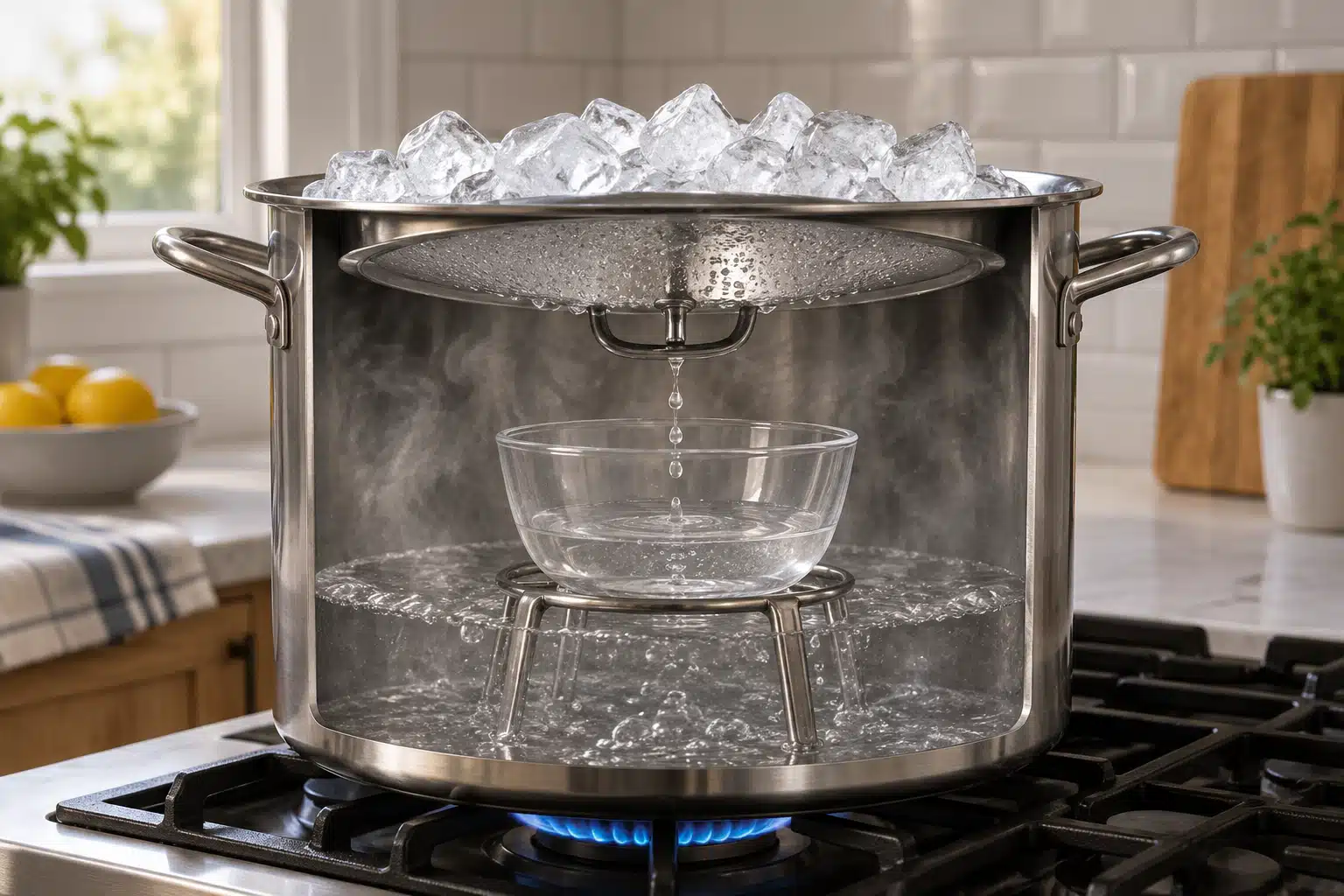
- Fill your stockpot about one-third full with tap water. Keep the level low enough so the boiling water won’t splash into your collection bowl.
- Place the heat-resistant collection bowl directly in the center of the pot. Ensure its rim sits well above the water line.
- Invert the pot lid over the stockpot so the handle points down, positioned directly above your collection bowl.
- Bring the water to a gentle boil over medium heat. Once it begins steaming, pile a generous layer of ice cubes onto the inverted lid.
- As steam rises and hits the chilled underside of the lid, it condenses into water droplets. Gravity pulls these droplets down to the center knob, where they drip straight into the bowl.
- As the ice melts, ladle off the excess water and add fresh cubes. Let the process run for roughly 45 to 60 minutes.
- Turn off the heat and let everything cool down completely. The pot, steam, and bowl will be scalding hot—always wear heat-resistant oven mitts when removing the bowl.
- Pour your freshly distilled water into a sanitized bottle, seal it tightly, and label it with the date.
Testing Purity and Quality
High-purity distilled water contains negligible dissolved minerals. You can verify this using an electrical conductivity (EC) meter or a Total Dissolved Solids (TDS) meter. An extremely low conductivity reading (in µS/cm) or a TDS reading hovering near zero confirms that the mineral content has been effectively eliminated.
Keep in mind that low mineral content does not mean the water is sterile. Certain volatile organic compounds have boiling points close to water and can carry over during distillation. Furthermore, even properly distilled water can harbor microbes if transferred into an unsterilized container.
Crucially, distilled water is never a substitute for a preservative system. Any formula containing water—such as mists, serums, or lotions—demands a broad-spectrum preservative to inhibit microbial growth. Reviewing how to safely store homemade cosmetics will help you maintain proper hygiene and shelf stability.
-
 €5.74 €297.52Price range: €6.95€5.74 through €360.00€297.52 incl. VAT inc. VATExcl. VATSelect options This product has multiple variants. The options may be chosen on the product page
 -
€2.44 €1,570.25Price range: €2.95€2.44 through €1,900.00€1,570.25 incl. VAT inc. VATExcl. VATSelect options This product has multiple variants. The options may be chosen on the product page
-
 €4.09 €156.98Price range: €4.95€4.09 through €189.95€156.98 incl. VAT inc. VATExcl. VATSelect options This product has multiple variants. The options may be chosen on the product page

Working Safely with Lye Solutions
If you plan to use your distilled water to dissolve lye for cold process soap, always take proper safety precautions. Dissolving sodium hydroxide in water triggers an exothermic reaction that produces intense heat and caustic vapors.
Always pour your lye beads slowly into the water—never the other way around. Adding water onto dry lye can cause a dangerous volcanic eruption of caustic liquid. Work in a well-ventilated space and wear full protective gear, including chemical splash goggles, gloves, and long sleeves. For precise measurements, refer to our guide on calculating lye water.
Distilled water is just as critical when formulating liquid soap. As outlined in our step-by-step guide to making liquid soap, even trace minerals from tap water will turn a crystal-clear liquid soap cloudy.
To stock up on quality ingredients, explore our collection of additives and raw materials, or check out our complete checklist of soap making supplies before you begin.
-
 €1.86 €181.78Price range: €2.25€1.86 through €219.95€181.78 incl. VAT inc. VATExcl. VATSelect options This product has multiple variants. The options may be chosen on the product page
 -
€3.26 €206.57Price range: €3.95€3.26 through €249.95€206.57 incl. VAT inc. VATExcl. VATSelect options This product has multiple variants. The options may be chosen on the product page

Formulate with Complete Control
Distilling water at home gives you full control over the foundation of your DIY skincare and soap creations. By stripping out hard water minerals and chlorine, you protect your batches from premature rancidity, cloudiness, and separation. Browse our extensive selection of ingredients in the cosmetics section to take your handmade formulations to the next level.


