
There is nothing quite like pouring a fresh batch of candles, but before you can truly enjoy or share them, you need to know they burn safely. A homemade candle brings warmth and ambiance into a living space, but it remains an open flame. Without proper testing, you run the risk of cracked glassware, heavy sooting, or runaway flames. A controlled burn test shows you exactly how your wax, wick, and fragrance perform together, giving you the confidence to gift or sell every piece you make.
Why You Must Test Every Candle
As a maker, product safety rests entirely on your shoulders. Whether you pour candles as gifts for loved ones or sell them through an online storefront, the General Product Safety Regulation (GPSR) applies to anyone putting goods on the market. Under these rules, you must be able to demonstrate that your products are safe under foreseeable conditions of use.
Every successful candle relies on a delicate balance among three key components: your choice of candle wax, the wick, and additives such as dyes or fragrance oils. A wick that burns flawlessly in plain wax can produce heavy soot once you introduce fragrance. Factors such as the flash point of fragrance oil also influence how your ingredients interact during combustion. Rigorous testing is the only dependable way to verify that your recipe is safe, stable, and performing as intended.
Safety Standards and Regulatory Requirements
In the European market, specific harmonized standards govern candle manufacturing. Standard EN 15493 outlines core fire safety criteria, including physical stability (the candle must remain upright on a 10-degree incline) and safeguards against secondary ignition. Standard EN 15494 specifies product labeling requirements and details the safety pictograms that must appear on your packaging.
Chemical limits are just as strictly enforced. Lead in wicks must not exceed 100 ppm, and volatile organic compounds such as toluene are closely regulated. While reputable suppliers provide raw materials that comply with these baseline thresholds, the finished blend is still your responsibility.
Precision during the pour matters just as much as your ingredient choices. Make sure you know how to prevent an off-center candle wick, as a displaced wick creates hot spots on the glass and poses a serious safety hazard.
Step-by-Step Guide to Conducting a Burn Test
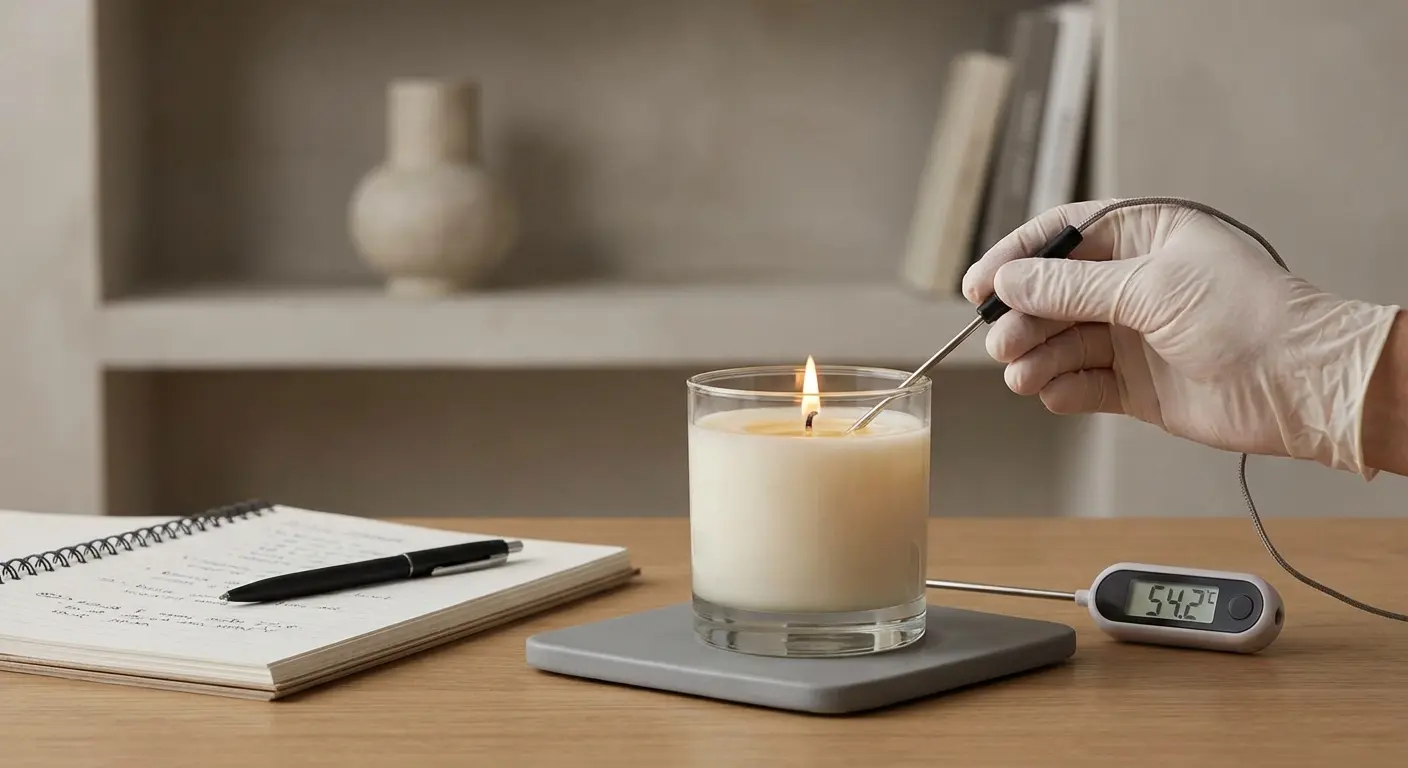
A reliable burn test mimics how an end user will burn the candle, conducted under controlled, observable conditions. Keep a dedicated logbook nearby to record your wick series, wax type, fragrance load percentage, and vessel dimensions.
- Allow the candle to fully cure before lighting it. Plant waxes such as soy generally need one to two weeks to stabilize.
- Trim the wick to approximately 5 mm (¼ inch) before each light. A sharp wick trimmer gives you a clean, precise cut.
- Set the candle on a level, heat-resistant surface, keeping it at least 30 cm away from combustible materials and shielded from drafts.
- Light the wick and let the candle burn for four continuous hours.
- Watch the flame closely during the first hour. It should burn calmly and upright; excessive flickering indicates a draft, an untrimmed wick, or an oversized wick.
- Check the melt pool during hours two and three. The liquid pool should reach the outer walls of the container within three to four hours.
- Extinguish the flame at the four-hour mark and allow the wax to cool and solidify for at least five hours before lighting it again.


Repeat this four-hour burn cycle across the entire lifespan of the candle. It usually takes three to four full test burns to get a true picture of how the wick behaves as the wax level drops. Stop burning permanently once about 6 mm (¼ inch) of solid wax remains at the bottom of the vessel.
Interpreting Results and Troubleshooting
Your observations during the test cycles will tell you everything you need to know about your formulation:
If a ring of unmelted wax clings to the glass walls, your candle is tunneling. This indicates that the wick is underpowered or too small for your jar diameter and wax blend. Learn how to fix candle tunneling and review our guidelines on choosing the right wick.
If you see an overly tall flame, heavy black smoke, soot gathering on the rim, or severe carbon build-up (mushrooming) on the wick tip, the candle is over-wicked. This generates excessive heat and risks thermal shock to the vessel. Choosing certified heat-resistant glass containers helps mitigate fracture risks, but you must still step down to a smaller wick size. For more detailed safety best practices, see our guide to container candle safety.
Natural waxes like soy burn cooler and denser than paraffin, so they often require larger or differently braided wicks. Browse our collection of candle wicks or read our guide on how to determine the right wick length to find the ideal match for your vessel.
Documentation and Mandatory Labeling
A clean burn test is essential, but proper documentation and warning labels are equally important for compliance. If you add fragrance oils to your wax, your products fall under European CLP (Classification, Labelling and Packaging) regulations.
- Clearly identify the product name and net weight on your packaging.
- Ensure all required hazard pictograms measure at least 1 cm by 1 cm.
- Include mandatory signal words such as “Warning” or “Danger” where applicable.
- Feature the standardized EN 15494 safety icons, including the universal directive to never leave a burning candle unattended.
- For blends that trigger hazard classifications, generate and print a Unique Formula Identifier (UFI code) for poison center notification.
Organize your burn test sheets, formulas, and batch codes into a technical compliance file. If an inspector or customer ever requests verification, you will have comprehensive documentation proving your product’s safety.
Professional Laboratory Testing
If you are preparing for wide retail distribution or your brand requires accredited third-party validation, independent laboratory testing is an excellent route. Accredited labs run formal fire safety evaluations under EN 15493 and quantify sooting limits according to EN 15426. Explore our professional candle testing services to learn more about third-party certification.



Testing every combination of wax, wick, and fragrance demands patience, but the peace of mind it delivers is invaluable. Set up your testing station, start your log, and build a collection of candles you know will burn cleanly, beautifully, and safely every time.


