
You’ve just poured a beautiful candle and waited impatiently for days for it to cure. You finally light it… and smell absolutely nothing. Or worse: the oil is floating on top of your creation like dangerous beads of sweat. The secret to a great scented candle isn’t just adding a “splash extra to be safe.” It comes down to precision and the chemistry between your wax and the fragrance.
The Golden Rule: Percentages and Saturation
For most candles, the ideal fragrance load lies between 6% and 10%. This percentage depends entirely on the type of wax you are using and the quality of the oil.
Think of candle wax as a sponge. A sponge can only hold a certain amount of water before it leaks. Candles work exactly the same way: every wax type has a saturation point. If you exceed this limit, the wax cannot hold the oil. The fragrance will either sink to the bottom or seep out of the top as droplets. Not only is this unsightly, but it is also a fire hazard, as pure fragrance oil is highly flammable.
We usually advise beginners to start with a safe 6% to 8%. If you have more experience and your wax allows for it, you can scale up to 10%. Trying to push 12% or higher? You will often need special additives. In practice, however, this rarely yields a better scent; instead, it often leads to burn issues, such as a sooty flame.
Ditch the Measuring Cups: Weighing in Grams
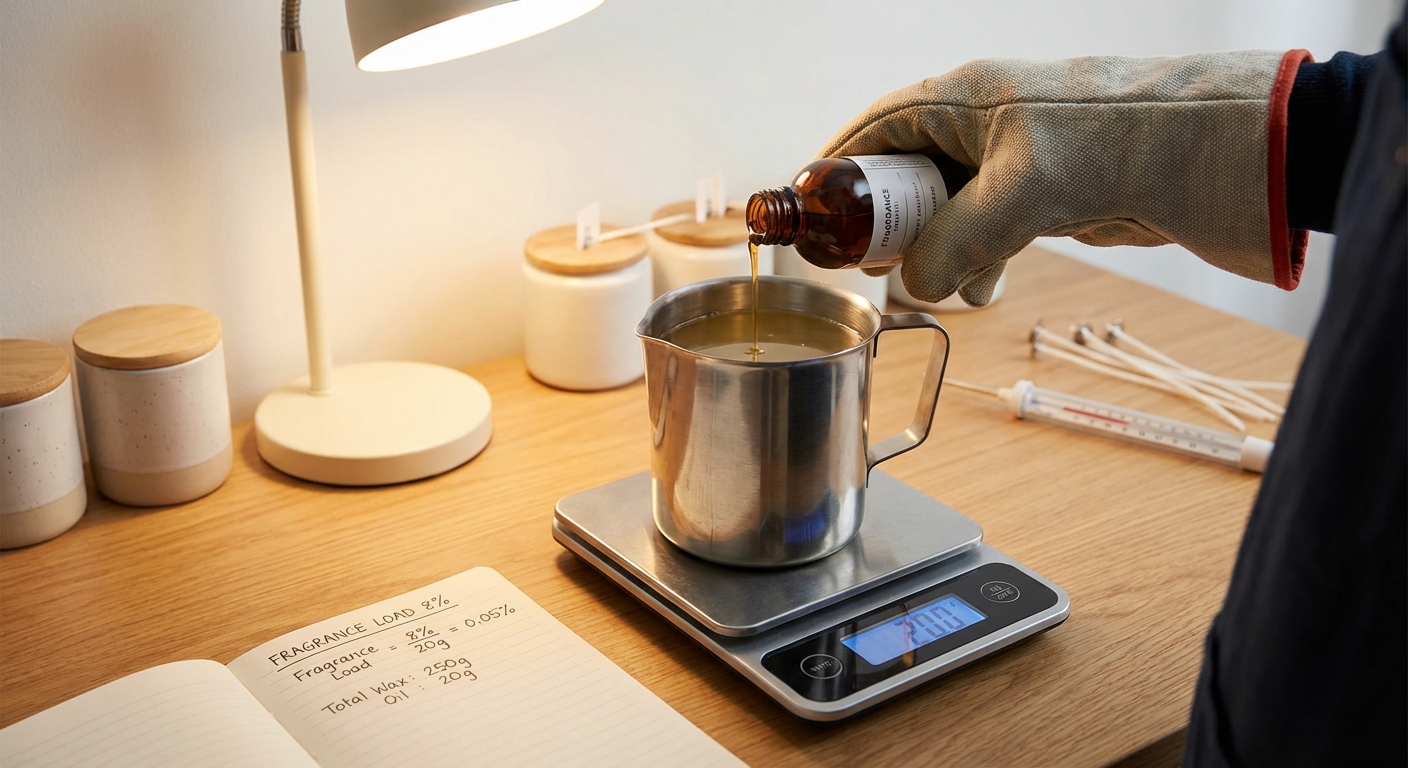
Put away your measuring cups and milliliters. In the world of candle making, we weigh everything in grams. Why? Because 100 ml of fragrance oil does not weigh the same as 100 ml of wax (oil is lighter). For consistent results, a digital scale is indispensable.
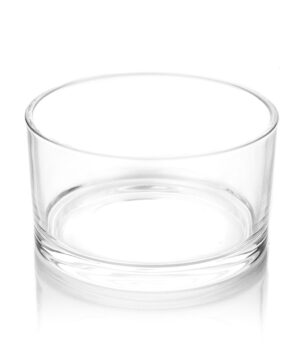
Fortunately, the formula to calculate your quantities is simple. Suppose you have a vessel that holds a total of 160 grams of mixture, and you want to use a fragrance load of 8%.
Your calculation looks like this:
- Total weight: 160 grams
- Fragrance oil (8%): 160 x 0.08 = 12.8 grams
- Wax: 160 – 12.8 = 147.2 grams
In this scenario, you would melt 147.2 grams of wax and add 12.8 grams of fragrance oil. This brings you exactly to your total volume and ensures the ratio is correct. This formula works for any container size.
Guidelines by Wax Type
Not all waxes are created equal. Natural wax behaves very differently from paraffin or gel. Here are the guidelines for each type:
#### Soy Wax and Natural Waxes
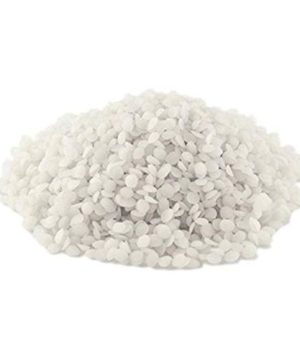
Natural waxes, such as soy wax, are known for a clean, slow burn. However, they sometimes struggle to “throw” scent into a room as easily as paraffin (this is known as ‘scent throw’). The maximum load for most soy waxes is around 10%. Because soy wax has a specific density, it is crucial to stir thoroughly so the oil binds properly to the molecules.
Beeswax is another beautiful, natural option. Keep in mind that beeswax has its own distinct honey scent, which can interfere with your fragrance. It is best to use a lower percentage here, around 6%.
-
€3.19 – €327.25 incl. VAT Select options This product has multiple variants. The options may be chosen on the product page
#### Paraffin
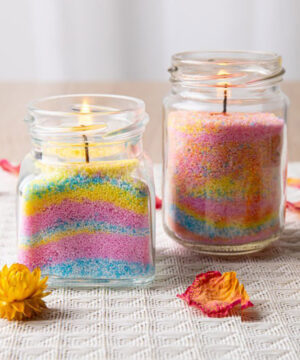
Paraffin is known as the champion of scent throw. Often, 6% fragrance oil is enough for a very strong candle. Some types of paraffin can handle more, but always check the manufacturer’s specifications. A fun variant to experiment with is candle sand. This is a powdered wax where you mix the scent and color simply by shaking it in a jar. Start cautiously with 3-5% to see how the mixture reacts.
-
€4.95 – €600.00 incl. VAT Select options This product has multiple variants. The options may be chosen on the product page
#### Gel Wax: Safety First
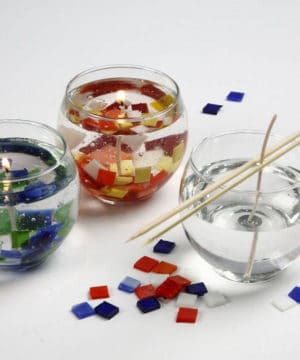
Gel wax is fantastic for transparent creations where you can suspend decorative elements, but you must be careful. The strict limit here is 6%. More importantly: you can only use non-polar fragrances in gel wax. If you use a polar fragrance, the gel will turn cloudy and the scent may separate, creating a serious fire hazard.
When in doubt, perform a test: mix a small amount of fragrance oil with mineral oil in a glass. Does it stay clear? Then it is safe. Does it turn cloudy? Do not use that fragrance in your gel candle.
-
€7.16 – €219.96 incl. VAT Select options This product has multiple variants. The options may be chosen on the product page

The Impact of the Wick
You can calculate the perfect amount of oil, but if your candle wick isn’t right, you still won’t smell much. The wick is the engine of your candle. When you add fragrance oil, the viscosity of the melted wax changes; it becomes “heavier” and sometimes harder for the wick to pull up.
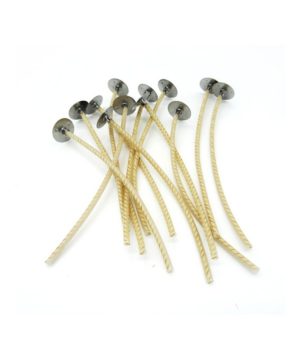
Often, with a higher fragrance load (8-10%), you need a slightly more powerful wick. The TCR series and Stabilo wicks, for example, are developed to perform well in systems with heavy fragrance and dye loads.
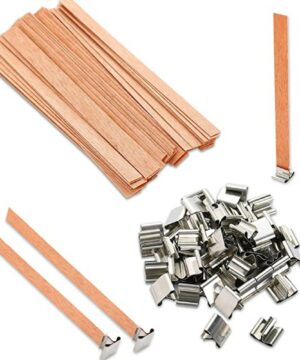
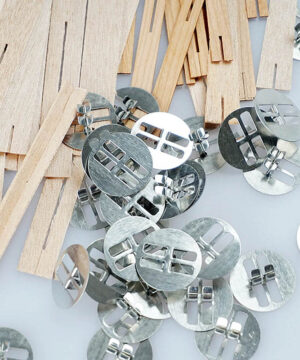
Want something special? Wooden wicks not only provide a fantastic crackling effect but often assist with scent distribution in wider containers because they create a broader melt pool.
-
€2.95 – €174.95 incl. VAT Select options This product has multiple variants. The options may be chosen on the product page
-
€4.95 – €369.95 incl. VAT Select options This product has multiple variants. The options may be chosen on the product page
-
€1.95 – €89.95 incl. VAT Select options This product has multiple variants. The options may be chosen on the product page


Temperature and Timing
The moment you add the fragrance oil is crucial for the final result. If you pour the oil into the pot while the wax is too hot, a large portion of the top notes will evaporate immediately. Your kitchen will smell delicious, but your candle won’t. If the wax is too cold, the oil won’t bind properly with the wax.
Research shows that 85°C is often the ideal temperature to add fragrance oil for optimal binding. Remove the wax from the heat source, check the temperature, and add your weighed oil.
Then comes the most important step that many people skip: stirring. Stir your wax mixture gently but constantly for at least two minutes. This might feel like a long time when you’re standing there, but it ensures that the oil and wax truly fuse together, preventing the oil from sweating out later.
Quality Over Quantity
There is a persistent misconception that “more oil” always equals “stronger scent.” This is incorrect. A high-quality candle fragrance oil is highly concentrated. Cheap oils often contain thinners or alcohol, meaning you need to use much more of them to get the same effect. This often ruins the burning properties of your candle.
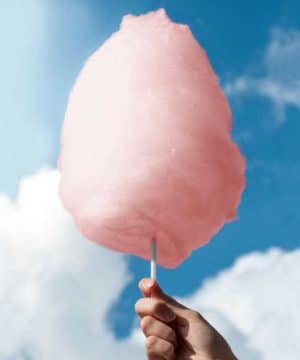
At YouWish, fragrance oils like our popular Cotton Candy are formulated to perform powerfully without needing to overload the wax. Often, a 6-8% load provides a room-filling result.
-
€2.19 – €16.43 incl. VAT Select options This product has multiple variants. The options may be chosen on the product page
Safety and Labeling (CLP)
As soon as you add fragrance oil to a candle, you are creating a chemical mixture. Are you selling your candles or giving them away? If you are in Europe, you are required to affix a CLP label (Classification, Labelling and Packaging) to your candle. This label warns the user of any allergens or flammability risks.
- Are you using 10% or less fragrance oil? Generally, a 10% CLP label is sufficient for most scents.
- Are you going above that (which we discourage for candles, but is sometimes done for wax melts)? Then you may need a more severe classification.
You can always find the specific information for these labels on our product pages under the SDS and Allergens sections.
A Step-by-Step Plan for Your Next Project
Finding the perfect ratio is a matter of testing and taking notes. Follow these steps for success:
- Choose your wax and jar: Determine how many grams fit in your container.
- Choose your percentage: Start safely with 6-8%.
- Calculate it: Total weight x 0.08 = grams of oil.
- Weigh accurately: Always use a scale.
- Watch the temperature: Add oil at around 85°C for the best binding.
- Stir: Stirring gently for 2 minutes is not a suggestion—it’s a necessity.
- Patience: Let the candle cure (especially with soy wax) for at least 1 to 2 weeks before judging the scent.
Keep a logbook of every candle you make. Note the percentage, the temperature, and the wick type. This is how you develop your own perfect recipe. Ready to begin? Dive into our candle making assortment and start experimenting.


