
You’ve just poured the perfect candle. The scent is divine, the vessel looks sleek, and the wax has cured to a smooth finish. But before you light, sell, or gift your creation, there is one crucial question you must answer: is it safe? Fundamentally, a candle is an open flame inside a home. Without proper testing, that cozy ambiance can quickly turn dangerous, leading to shattered glass or a flashover. Conducting a proper burn test isn’t just a good idea; for anyone bringing candles to market, it is a requirement. In this article, you will learn exactly how to test your candles, which regulations you must comply with, and how to interpret your results.
Why Testing Is Mandatory
As a maker, you are responsible for the safety of your product. Whether you are a hobbyist gifting to friends or a small business owner, the rules apply to everyone placing a product on the market. Candles must comply with the General Product Safety Regulation (GPSR), which essentially means you must be able to demonstrate that your candle is safe for normal use. Furthermore, testing is the only way to determine if your specific combination of wick, wax, and fragrance actually works. A candle wick that burns perfectly in unfragranced wax can easily fail or drown the moment you add fragrance oil.
Key Safety Standards
Europe has established specific EN standards for candles. While you may not need a professional laboratory as a small maker, you must be familiar with these guidelines. EN 15493 specifies fire safety requirements. This includes stability (the candle must not tip over on a 10-degree slope) and the risk of secondary ignition. EN 15494 covers labeling, determining which safety pictograms and warnings are mandatory on your packaging.
There are also chemical restrictions to consider. For example, lead content in wicks must not exceed 100 ppm, and substances like toluene and benzene are strictly limited. Fortunately, most raw materials from specialized suppliers are manufactured to meet these baseline requirements. Your primary task is to test how these materials react when combined in your specific recipe.
Step-by-Step: Performing Your Own Burn Test
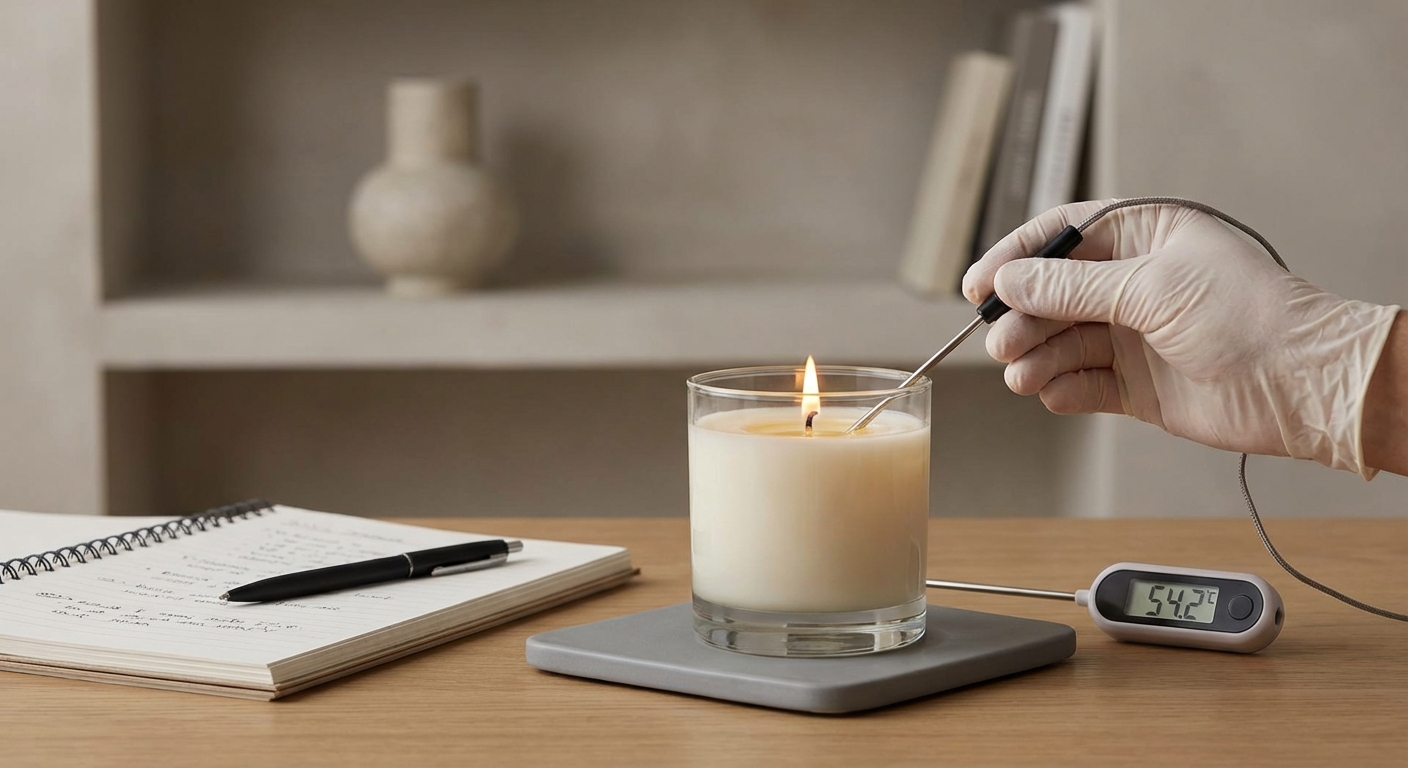
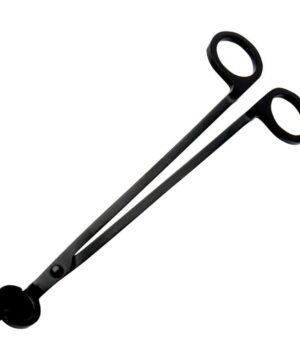
A burn test involves more than just lighting the candle to see if it works. You are simulating consumer behavior in a controlled environment. Ensure you keep a logbook to record notes for each test round. Start with a fully cured candle. For soy wax, this often means waiting at least one to two weeks; testing too early will yield unreliable results. Always trim the wick to approximately 5mm before starting, just as you would expect the end user to do.
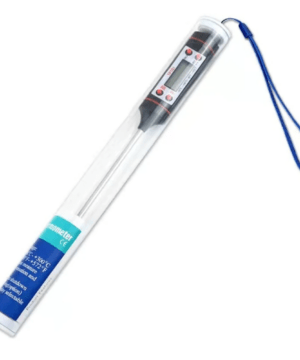
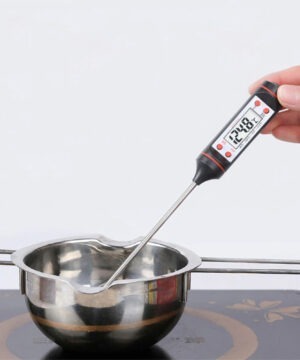
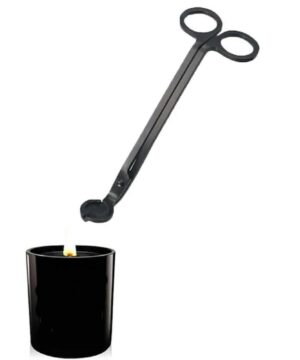
Light the candle and burn it in sessions of no more than four hours. This standard cycle is the industry guideline.
- Hour 1: Check if the flame is stable. If it flickers wildly, the wick may be too long, or there may be a draft.
- Hours 2 & 3: Observe the melt pool. Ideally, the melted wax should reach the edge of the glass within three to four hours.
- Hour 4: Extinguish the candle. Check the temperature of the glass; it should not be too hot to touch safely.
Pay close attention to soot formation during and after the burn. Black smoke or soot on the rim of the glass indicates incomplete combustion. The flame should not be excessive; for container candles, a compact flame of 2–3 cm is ideal. If a thick wall of wax remains on the sides, this is called “tunneling.” If a carbon ball forms at the tip of the wick, you are experiencing “mushrooming,” which can cause debris to fall into the wax.
-
€2.95 – €174.95 incl. VAT Select options This product has multiple variants. The options may be chosen on the product page
-
€1.95 – €89.95 incl. VAT Select options This product has multiple variants. The options may be chosen on the product page
Troubleshooting and Interpreting Results
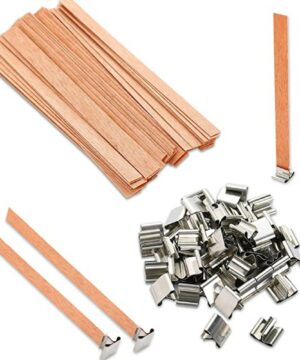
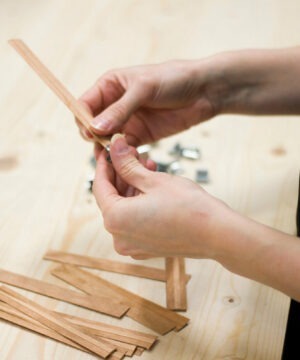
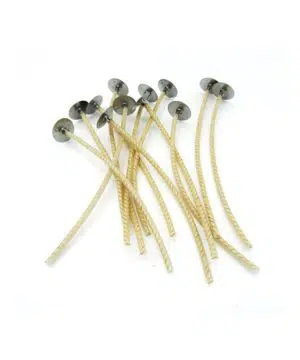
Finding the right formulation is often a process of trial and error. It is rare for a first test to be perfect. If your candle is tunneling and burning only down the center, the wick lacks the power to melt the wax out to the edge. You likely need to size up or try a different wick series. Read more here about choosing the right wick for your project.
Conversely, are you seeing a large, smoking flame, or is the glass becoming dangerously hot? Your candle is likely “over-wicked.” This is more dangerous than tunneling because the heat can cause the glass to shatter. While using safe, heat-resistant glass containers is essential, it does not solve the root problem of using a wick that is too large.
-
€1.85 – €1,350.00 incl. VAT Select options This product has multiple variants. The options may be chosen on the product page


Your choice of wax also plays a major role. Soy wax, such as Golden Wax 464, behaves differently than paraffin. Sometimes, if you cannot achieve the desired result with wick adjustments alone, it may help to switch your candle wax.
-
€5.95 – €3,300.00 incl. VAT Select options This product has multiple variants. The options may be chosen on the product page

Labeling and Documentation: CLP and UFI
Beyond the physical burn test, your paperwork must be in order. If you add fragrance oil, your product falls under CLP (Classification, Labelling and Packaging) legislation. EU rules dictate that your label must contain clear product identification so consumers know what is inside. Hazard pictograms must be at least one square centimeter in size and accompanied by signal words such as “Warning” or “Danger.” Starting in 2025, a UFI code will be mandatory for many mixtures to assist emergency services in cases of poisoning. You can read more about this in our article on when a UFI code is required.
Do not forget the general safety pictograms from the EN 15494 standard, such as the icon warning never to leave a burning candle unattended. If you plan to make candles for sale, it is wise to create a professional CLP label. The necessary data (SDS/MSDS) is available for our fragrance oils, so you know exactly which allergens must be declared.

Document Everything
Carefully archive the results of your burn tests. Should a complaint ever arise, your technical file serves as proof that you acted with due diligence. This file should contain your recipe, batch numbers of raw materials used, test reports, and a copy of the label. If you want absolute certainty, or if you are moving into large-scale production, consider having professional laboratory tests performed.
Safety might seem like a hassle, but it is the foundation of a quality product. You can only truly enjoy the creative process when you know your candle burns safely. Start small, test thoroughly, and build a brand that people can trust.


